Govind Dev is the most architecturally impressive temple of Vrindavan and was, for the brief decades between its completion in 1590 and its damage in 1670, perhaps the finest Hindu temple in northern India. Tradition tells that the original Govind Dev deity was found by Rupa Goswami at Goma Tila on the Yamuna bank, where Krishna himself had buried him at the end of his Dvapara-yuga lila. The deity was first worshipped in a small shrine and then in this grand mandir built by Raja Man Singh of Amber (later of Jaipur), Akbar's great Rajput general.
The temple is built of red sandstone in a style that fuses the Nagara shikhara with Mughal arches, vaulted ceilings, and central-dome construction unusual for a Hindu temple. The original shikhara rose seven storeys (visible from Agra, sixty kilometres away) and was topped by a great gold kalasha. Tradition says that Akbar himself was so impressed by the structure that he praised it; it was Aurangzeb who, decades later, ordered the upper storeys destroyed and the central dome filled.
The deity
When Aurangzeb's persecution threatened the deities of Vrindavan, Govind Dev was transferred to Jaipur via Govindgarh, Radhakund, and several intermediate halts. The original murti now resides in the City Palace at Jaipur where he is worshipped as the family deity of the Maharaja. A replica continues to be served at the original temple in Vrindavan. The Jaipur deity remains, for the royal family, the principal Vaishnava authority — Govind Dev is, in tradition, the head of the Vrindavan saptadevalaya.
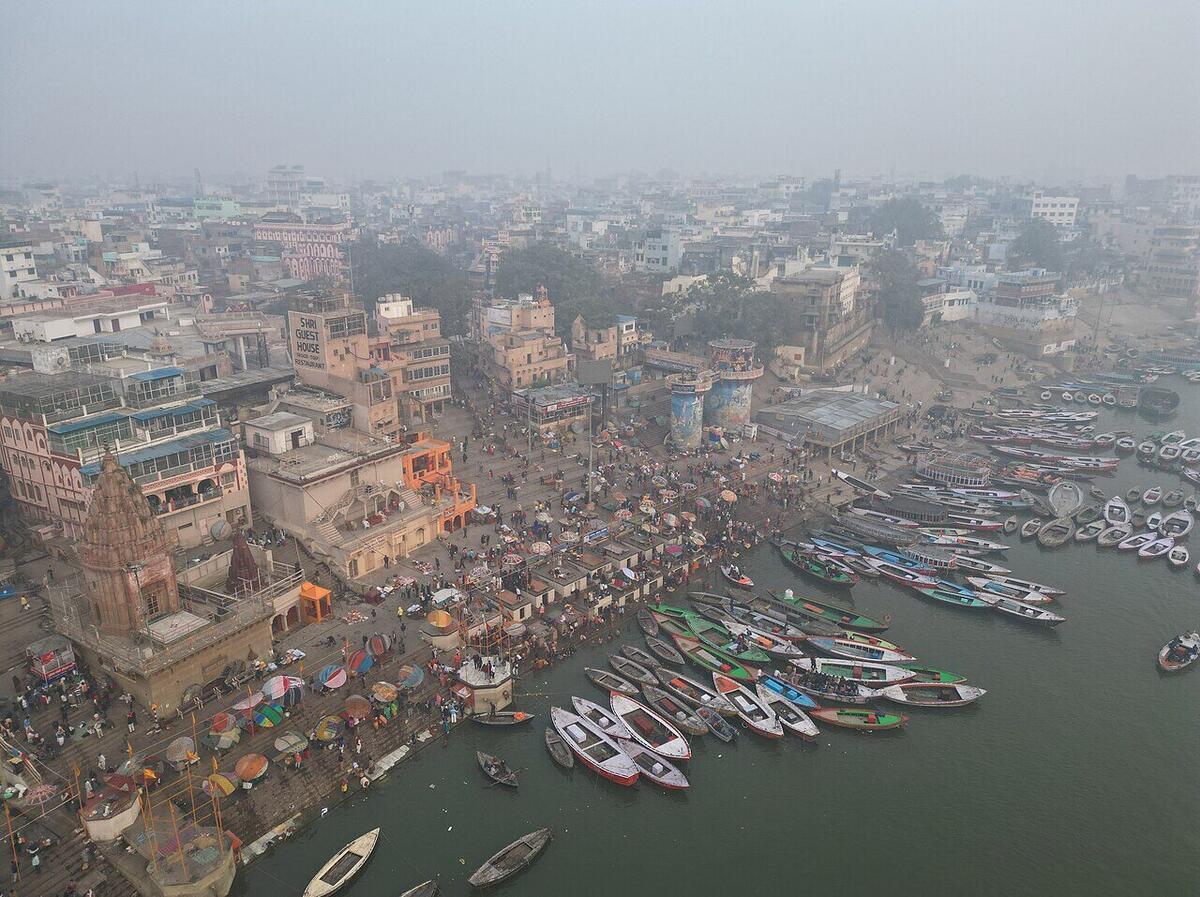
Govind Dev is the principal seat among the saptadevalaya of Vrindavan and is held by the Gaudiya tradition to be the senior-most thakur. The Six Goswamis of Vrindavan each had their primary deity, and Rupa Goswami's Govind Dev was the eldest among them. Sri Chaitanya Mahaprabhu's lineage flows through the Govind Dev seat into the modern Gaudiya world.
Tradition holds that the original deity was self-manifest — Krishna himself had buried him at the end of the Dvapara age to be rediscovered when needed. The lila of his rediscovery by Rupa Goswami is told and retold in Gaudiya literature; the cow that gave milk daily at Goma Tila led Rupa Goswami to the buried deity.
History
Raja Man Singh of Amber (1550-1614) — Akbar's great Hindu general and a leading patron of Vaishnava bhakti — funded the building of Govind Dev between 1576 and 1590. The original architect is said to have been a master craftsman from Bengal who fused Rajputana, Bengal, and Mughal sensibilities. The temple was the largest and most lavish Vaishnava structure of its time.
In 1670, Aurangzeb ordered the destruction of the upper storeys; the central dome was filled with rubble to prevent its collapse, and the gold kalasha was carried off. The original deity was evacuated to Jaipur. The structure that survives — about three storeys of the original seven — was conserved by the Archaeological Survey of India in the twentieth century. Worship in the original mandir continues with a replica deity served by the Goswamis of the Govind Dev lineage; the Jaipur murti continues to be the principal Govind Dev of the tradition.
Architecture
The surviving structure is a remarkable hybrid: Nagara shikhara base, Bengal-style chala roofing fragments, Mughal arches in the main hall, and a vaulted central chamber with a high dome. The interior is carved with floral arabesques in the Mughal style alongside Vaishnava motifs (cow-bells, lotuses, conch shells). The temple is built of pink-red sandstone from Bayana in Rajasthan.
The main hall — the only fully-preserved section — is one of the largest temple interiors in northern India of the pre-modern period, with a central dome rising about 28 metres above the floor. The original temple complex spanned over 100 acres; today the protected zone is about 5 acres.
Rituals & Practices
The Vrindavan Govind Dev temple conducts a simpler daily seva than its Jaipur counterpart — Mangala Arati, Sringar Darshan, Rajbhog, Sandhya, and Shayan. The Jaipur Govind Dev follows the full eight-darshan Pushti-influenced rhythm with elaborate seasonal ornamentation; pilgrims who can travel may visit both.
The temple is open through the day with brief midday pauses. Photography is permitted in the outer hall and the courtyard (excellent for the architecture) but not in the inner sanctum.
Festivals & Celebrations
| Festival | When | Crowd |
|---|---|---|
| Govind Dev Appearance Day | — | high |
| Janmashtami | — | very_high |
| Kartik Purnima | — | very_high |
| Phool Bangla | — | high |
Govind Dev Appearance Day: Founding day of Govind Dev worship in modern Vrindavan.
Janmashtami: Krishna''s birthday.
Kartik Purnima: The most beloved Vaishnava full-moon of the year.
Phool Bangla: The seasonal seva-shringar tradition.
Prepare for Your Visit
Practical guidance to help you plan your pilgrimage
| Pilgrim Guidance | How to reachGovind Dev is on the eastern edge of old Vrindavan, near the Vrindavan Sevakunj and a short walk from the Yamuna. From the parikrama-marg, e-rickshaws drop pilgrims at the temple gate. Mathura Junction (12 km) is the railhead. PreparationModest dress; full-sleeved kurtas and full-length lower garments. The temple is a protected ASI monument as well as an active shrine — respect the conservation markers. Best time to visitOctober to March for pleasant weather. Janmashtami, Kartik Purnima, and the Govind Dev appearance day are the major spiritual peaks. Early morning is best for the architecture; the play of light through the vaulted ceilings is remarkable. |
Location
Mathura, UP
Pilgrim photos
No pilgrim photos yet.
Community corrections
No corrections yet.
Edit history
No revisions yet.
Plan Your Visit to Govind Dev Temple
Get a custom itinerary and pricing for your trip.
Recommended
Packages for this destination
Pilgrim Notes
On-ground observations from fellow pilgrims
No pilgrim notes yet. Be the first to share on-ground observations!
Sign in to share a note.
Pilgrim Reviews
Be the first to share your experience at Govind Dev Temple.
Sign in to write a review.
Nearby sacred places
Discover other sacred places near Govind Dev Temple
Explore temples, tirthas, and pilgrimage sites in UP
Explore nearbyPart of these circuits
Walk the traditional pilgrimage routes this destination belongs to.