Kanak Bhawan is the temple of Shri Ram and Sita in their grihastha-bhav — the sweet, intimate form of the married couple. The tradition holds that this was the very palace given by Queen Kaikeyi (Bharat's mother) to Sita on her wedding day, as a personal residence for the newly-wed bride within the larger Ayodhya complex. Sita and Ram are said to have stayed here during their married years before vanvas, and the bhakti tradition holds them to remain accessible here in this domestic, loving form.
The sanctum holds three pairs of Ram-Sita murtis. The principal pair — golden in colour, dressed in golden ornament — is set in the centre. Above and below are smaller pairs. The murtis are dressed daily in seasonal silks, garlanded with fresh flowers, and surrounded by mirror-work that gives the impression of countless reflections. Pilgrims often spend long minutes simply gazing at the bhav of the divine couple.
Katha of the wedding gift
The Ramcharitmanas and the local oral tradition tell that after Ram and Sita's marriage at Mithila, the Ayodhya households of Kaushalya, Sumitra, and Kaikeyi each gifted Sita a residence within the royal complex. Kaikeyi's gift — described as kanak (golden) in scripture — was the most personally lavish, given with great affection. After Ram, Sita, and Lakshman left for vanvas, Kaikeyi visited the building daily to long for their return. Tradition further holds that during the fourteen years of vanvas, the building remained shut and untouched; on Ram's return, the family resumed their married years here. The bhav of Ram-Sita in Kanak Bhawan is therefore the bhav of homecoming and shared married joy.
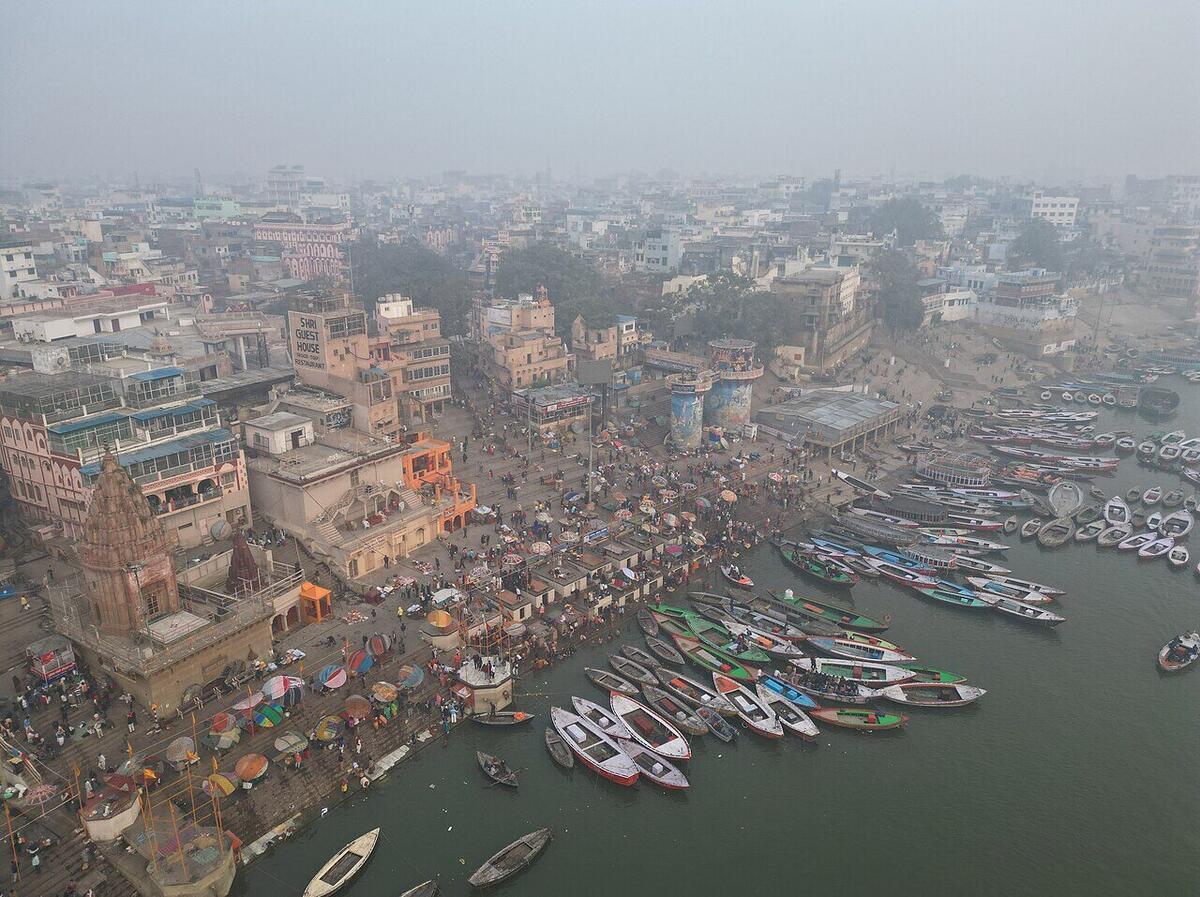
Kanak Bhawan is held by the Vaishnava tradition to be the most intimate Ram-Sita shrine in Ayodhya. While the Ram Janmabhoomi gives the bhav of the avatar's birthplace, and Hanuman Garhi the bhav of his service, Kanak Bhawan gives the bhav of married love — the sweet, ordinary, human dimension of the divine couple. For many devotees, the Kanak Bhawan darshan is the most heart-opening moment of their Ayodhya yatra.
The Tikamgarh-Bundeli tradition that rebuilt the temple in 1891 brings its own devotional emphasis — the bhajan-mandalis at Kanak Bhawan have a distinctive Bundeli musical style, with the harmonium, dholak, and manjira that flow through the day. Tuesdays and Saturdays see the largest gatherings; the post-Sandhya Arati bhajan often lasts an hour and is among the most beloved devotional moments at any Ayodhya temple.
History
The tradition of Kanak Bhawan as the gifted royal residence reaches into the Ramayana itself. The site as a continuously revered Vaishnava temple is documented from the medieval period. The present structure was rebuilt by Maharani Vrishbhanu Kunwari of Tikamgarh in 1891 after the older shrine fell into disrepair; she and her husband Maharaja Sir Pratap Singh of Tikamgarh financed the rebuilding in the Bundeli haveli-mandir style of their home region. The temple has continued under the trusteeship of the Tikamgarh family in subsequent generations.
The Maharani is said to have had a vision of Ram-Sita asking her to rebuild the shrine, and her devotion to the temple is locally remembered through bhajans and small plaques in the courtyard. The annual Kanak Bhawan Sthapana Diwas marks the rebuilding anniversary.
Architecture
Kanak Bhawan is built in the Bundeli haveli-mandir style typical of Tikamgarh patronage — three storeys, painted exterior in cream and ochre, with carved jharokha windows and a central courtyard. The shikhara is modest in scale but the structure's charm lies in the interior; the sanctum walls are inset with thousands of small mirrors that catch every flicker of lamp-light, creating an atmosphere of luminous intimacy.
The garbha-griha holds the three Ram-Sita murti pairs on a single throne. The walls of the inner shrine are painted with Ramayana scenes in the Bundeli folk style. Side rooms house the Tulsidas Smriti corner (preserving manuscript pages of the Ramcharitmanas), a small Hanuman murti, and the Tikamgarh family's memorial plaques.
Rituals & Practices
Kanak Bhawan conducts five daily aartis — Mangala (around 5:30 AM), Sringar (around 9:30 AM), Rajbhog (around noon), Sandhya (around 7:00 PM), and Shayan (around 10:30 PM). The Bundeli bhajan-tradition continues through the day between aartis. Verify exact timings on the day of darshan.
The traditional sequence at Kanak Bhawan is to enter, do darshan at the principal Ram-Sita murti, walk around the courtyard, pause at the Tulsidas Smriti corner, and sit for a few minutes for the Bundeli bhajan. Many pilgrims also visit the small Hanuman murti before leaving. On Sandhya Arati the small lamps lit by the priests reflect endlessly in the mirror-work walls — the image is one of the most beloved among Ayodhya devotional photographs.
Festivals & Celebrations
| Festival | When | Crowd |
|---|---|---|
| Vivah Panchami | — | very_high |
| Ram Navami | — | very_high |
| Sita Navami | — | high |
| Deep Utsav | — | very_high |
| Kanak Bhawan Sthapana | — | high |
Vivah Panchami: The wedding day of the divine couple â the supreme festival at Kanak Bhawan.
Ram Navami: Honours Ram in his birth-place.
Sita Navami: Honours Sita as Maharani of Ayodhya.
Deep Utsav: Honours Shri Ram''s return from vanvas.
Kanak Bhawan Sthapana: Honours the modern restorer of the temple.
Prepare for Your Visit
Practical guidance to help you plan your pilgrimage
| Pilgrim Guidance | How to reachKanak Bhawan is in central Ayodhya, walking distance from Hanuman Garhi (5 minutes) and Ram Janmabhoomi (10 minutes). Cycle-rickshaws drop pilgrims at the temple lane. Ayodhya Dham railway station is 3 km; AYJ airport is 6 km. PreparationModest dress. Mobile phones permitted in the outer courtyard but not in the sanctum (where photography is restricted). Footwear off at the entrance — cloakroom available. The Bundeli bhajans are open to all to join; sit quietly and listen if you prefer. Best time to visitOctober to March for pleasant weather. Tuesdays and Saturdays for the largest bhajan gatherings. Ram Navami and Vivah Panchami (Ram-Sita's wedding anniversary in Margashirsha — November-December) are the spiritual peaks. Deep Utsav (Kartik) sees the entire structure illuminated with diyas. Sandhya Arati on any day is the most beautiful single moment. |
Location
Ayodhya, UP
Pilgrim photos
No pilgrim photos yet.
Community corrections
No corrections yet.
Edit history
No revisions yet.
Plan Your Visit to Kanak Bhawan
Get a custom itinerary and pricing for your trip.
Recommended
Packages for this destination
Pilgrim Notes
On-ground observations from fellow pilgrims
No pilgrim notes yet. Be the first to share on-ground observations!
Sign in to share a note.
Pilgrim Reviews
Be the first to share your experience at Kanak Bhawan.
Sign in to write a review.
Nearby sacred places
Discover other sacred places near Kanak Bhawan
Explore temples, tirthas, and pilgrimage sites in UP
Explore nearbyPart of these circuits
Walk the traditional pilgrimage routes this destination belongs to.