Krishna Janmasthan is the birthplace of Shri Krishna — the place the Bhagavata Purana, the Vishnu Purana, and the long Krishna-katha tradition all turn to as the foundational lila-sthal. The complex sits in the old city of Mathura, near the Vishram Ghat on the Yamuna. The site is held to be Kansa's prison, where Devaki and Vasudeva were held captive, and where at midnight on Bhadrapada Krishna Ashtami, Krishna was born.
The present temple complex includes the Garbha-Griha shrine (the underground prison-cell where Krishna's descent is held to have happened), the Keshavdev Mandir (the principal above-ground temple), and several smaller subsidiary shrines. The entire complex spans about 13 acres and is managed by the Shri Krishna Janmasthan Seva Sansthan Trust.
Katha and local belief
The Bhagavata Purana tells the well-loved katha. Kansa, the asura-king of Mathura, imprisoned his sister Devaki and brother-in-law Vasudeva after a divine voice told him that Devaki's eighth child would slay him. Six newborns were killed; the seventh (Balaram) was transferred to Rohini's womb. At midnight on Bhadrapada Krishna Ashtami, Krishna was born — the divine voice in the prison saying "Sarva Dharman Parityajya..." — the prison locks opened by divine grace; Vasudeva carried the infant across the swollen Yamuna to Gokul.
The cell where this is held to have happened is preserved as the Garbha-Griha within the temple complex. Pilgrims descend a short flight of stairs into the underground shrine; the murti of bal-Krishna in a cradle is venerated at the very spot of his descent. Many pilgrims report this as the deepest darshan of their Braj yatra.
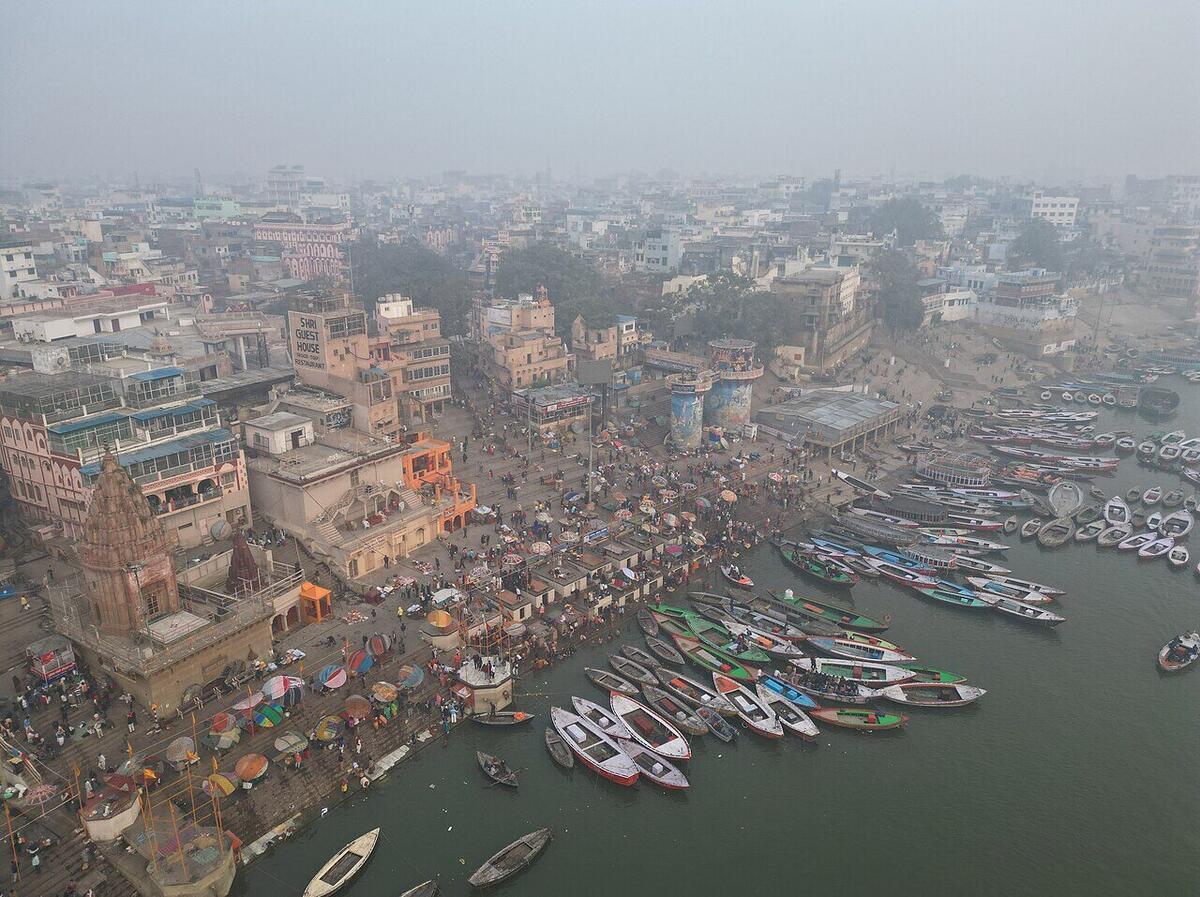
Krishna Janmasthan is the holiest place of Mathura — one of the seven Mokshapuris of Sanatan Dharma. The Garuda Purana names Mathura along with Ayodhya, Kashi, Haridwar, Dwarka, Kanchi, and Ujjain. Tradition holds that the merit of bathing at Vishram Ghat and bowing at the Janmasthan together is the supreme blessing of Mathura.
The Vaishnava sampradayas all turn here in their devotional life — the Gaudiya, Pushti Marga, Nimbarka, Ramanuja, Madhva, and Vallabh traditions. Many devotional songs of the Ashtachhap poets (Surdas, Paramananddas, Kumbhandas, and others) celebrate the moment of Krishna's birth in the Mathura prison. The midnight aarti on Janmashtami at the Garbha-Griha is held to be the most sacred moment of the Vaishnava year.
History
Krishna Janmasthan was an important Krishna shrine from antiquity. Archaeological surveys have placed Vaishnava worship at this site to at least the early historical period. The temple has a long and well-documented history of multiple rebuildings; the present complex was built in stages through the twentieth century by the Krishna Janmasthan Trust.
The adjoining structure on the same compound is a contested heritage that continues to be the subject of ongoing legal proceedings. Pilgrims focus on the Janmasthan temple complex and the underground Garbha-Griha; the Trust manages the orderly darshan, the Janmashtami celebrations, and the daily rituals.
Architecture
The Krishna Janmasthan complex is built in a regional north-Indian style. The Keshavdev Mandir is a large modern temple with a high shikhara and carved stone work. The Garbha-Griha shrine — the underground prison-cell — is preserved within a small enclosure with an entrance gate; pilgrims descend stone steps into the dimly-lit underground sanctum.
Around the complex are subsidiary shrines to Balaram, Yashoda, Devaki and Vasudeva, and small bhajan-halls. The Bhagavata Bhavan (the building housing the Garbha-Griha) is set apart from the main Keshavdev structure and is the focal point for darshan.
Rituals & Practices
The complex conducts five daily aratis at the Keshavdev Mandir — Mangala (shortly after sunrise), Shringar, Rajbhog (noon), Sandhya, and Shayan. The Garbha-Griha has its own quieter darshan rhythm with brief pauses between aartis. Verify exact timings with the Trust on the day of darshan.
The most famous moment of the year is the Janmashtami midnight aarti at the Garbha-Griha — the very moment of Krishna's birth, observed at the very spot of his birth. The aarti is broadcast globally and is among the most-watched darshan in the Hindu calendar. The temple is open for darshan from before dawn through late at night during the Janmashtami week.
The traditional sequence at Mathura is: bath at Vishram Ghat (3 km from Janmasthan), darshan at Krishna Janmasthan (Garbha-Griha first, then Keshavdev), then Dwarkadhish Mandir in the old city. Many pilgrims also do the Mathura parikrama which connects all the major shrines.
Festivals & Celebrations
| Festival | When | Crowd |
|---|---|---|
| Janmashtami | — | very_high |
| Nand Mahotsav | — | very_high |
| Holi | — | very_high |
| Geeta Jayanti | — | high |
Janmashtami: The supreme darshan of the Vaishnava year.
Nand Mahotsav: Honours the joy of Krishna''s arrival in Nanda''s home.
Holi: Honours Krishna''s playful lila.
Geeta Jayanti: Honours Krishna''s teaching.
Prepare for Your Visit
Practical guidance to help you plan your pilgrimage
| Pilgrim Guidance | How to reach Krishna JanmasthanThe complex is in central Mathura, 1 km from Mathura Junction railway station and 2 km from Vrindavan. From the station, e-rickshaws and cycle-rickshaws drop pilgrims at the temple gate. Delhi (145 km, 2.5 hours by Yamuna Expressway) is the nearest international airport. Vrindavan (12 km, 30 minutes) is usually combined with Mathura in a single yatra. Preparation for pilgrimsSecurity is robust at the Janmasthan — mobile phones, cameras, leather wallets, smart watches, and large bags are not permitted inside. Cloakroom available at the entrance. Wear modest clothes; carry minimal items. The queue can be long, especially on weekends, Janmashtami week, and festival days; plan extra time. Best time to visitOctober to March is the most pleasant weather. Janmashtami in Bhadrapada (August-September) is the spiritual peak — the midnight aarti at the Garbha-Griha is unforgettable. Holi in Phalguna (March) is also major. May-June is very hot. The Trust portal has darshan and special-puja booking for those who wish to be at the front during festivals. |
Location
Mathura, UP
Pilgrim photos
No pilgrim photos yet.
Community corrections
No corrections yet.
Edit history
No revisions yet.
Plan Your Visit to Krishna Janmasthan
Get a custom itinerary and pricing for your trip.
Recommended
Packages for this destination
Pilgrim Notes
On-ground observations from fellow pilgrims
No pilgrim notes yet. Be the first to share on-ground observations!
Sign in to share a note.
Pilgrim Reviews
Be the first to share your experience at Krishna Janmasthan.
Sign in to write a review.
Nearby sacred places
Discover other sacred places near Krishna Janmasthan
Explore temples, tirthas, and pilgrimage sites in UP
Explore nearbyPart of these circuits
Walk the traditional pilgrimage routes this destination belongs to.