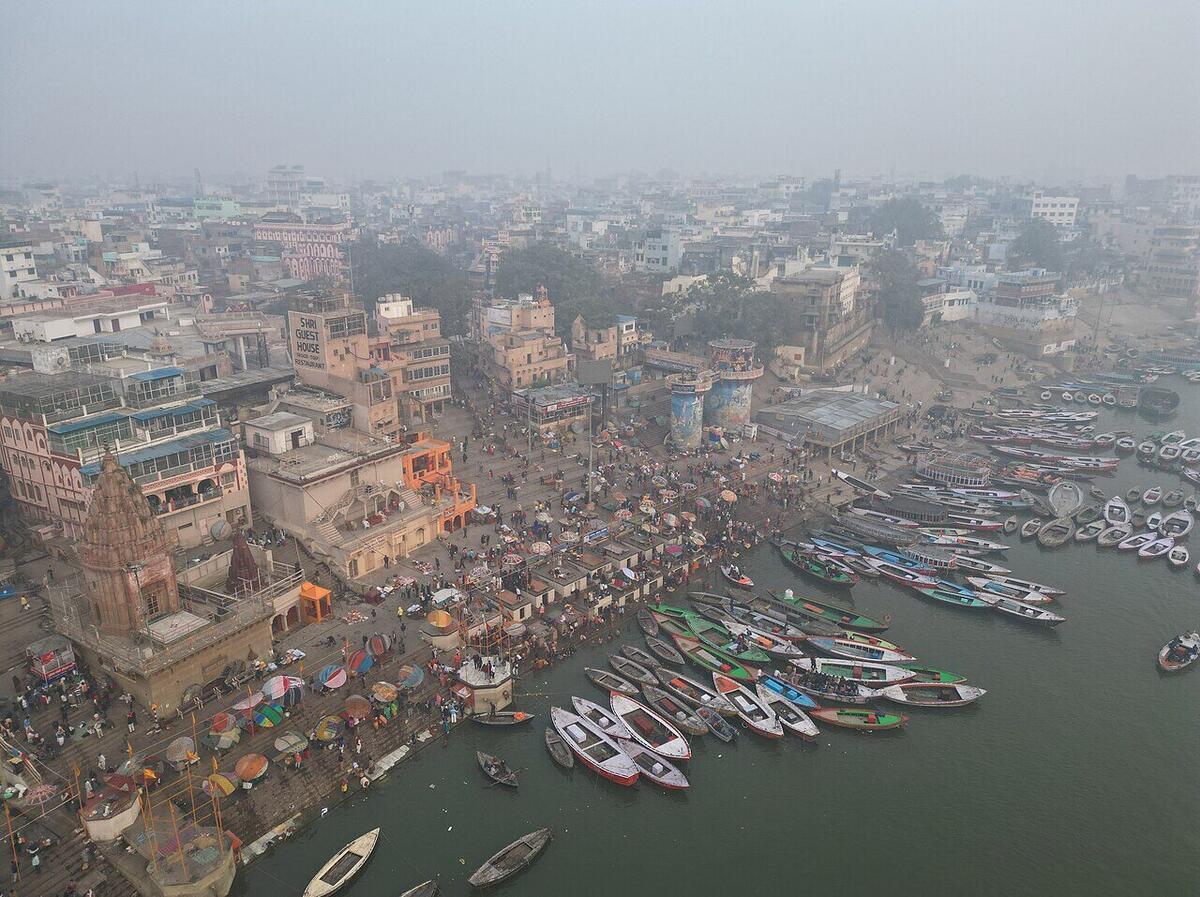
Lakshman Qila sits on the Saryu-bank in old Ayodhya, between Ram Ki Paidi and the Guptar Ghat. The site is dedicated to Lakshman — younger brother of Shri Ram, the constant companion through the vanvas, the slayer of Indrajit, and the one who embodied dharma in service. Tradition holds that this is the place where Lakshman performed his tapas during Ram's rule, and where he finally entered the Saryu at the close of his lila — preceding Shri Ram in returning to Vaikuntha by a short interval.
The shrine is small — a courtyard temple with a sanctum holding the murti of Lakshman in seated posture, with his sword (Lakshman is always shown with the sword as his identifying attribute) and folded hands. Side chambers hold subsidiary murtis of Ram-Sita and Hanuman. The atmosphere is contemplative — Lakshman is held by tradition to be the dharma-bhrata, the brother who put dharma above all; the shrine reflects this with its quiet, reflective bhav.
The departure katha
The Uttara Kanda of the Ramayana tells the long and moving katha of Lakshman's departure. Yama (the lord of death) had come to Shri Ram in the form of a sage with a secret request — that no one else should be permitted in the chamber during their meeting, on pain of death. Lakshman stood guard. Maharishi Durvasa arrived, demanding entry; Lakshman, knowing the cost, allowed himself to break the conditional and entered the chamber to announce the muni. Bound by his own decree, Shri Ram had to acquiesce. Lakshman, having fulfilled his dharma even to his own death, walked to the Saryu, performed his final tapas, and entered the waters. This is the spot remembered as Lakshman Qila.
Lakshman Qila is the temple of the ideal of seva-bhrata-dharma — service to one's elder, brotherly loyalty, the placing of duty above self. For many Vaishnava devotees, especially those drawn to the bhakti of self-sacrifice, the darshan at Lakshman Qila is deeply meaningful. Tradition holds Lakshman to be the partial-avatar of Sheshanaga, the cosmic serpent on whom Vishnu rests; this is why Lakshman is shown with the snake-canopy in many later iconographic traditions.
History
The Lakshman Qila tradition reaches into the Ramayana itself. The present temple was rebuilt during the medieval period under various Awadhi patrons; it received its most significant renovation in the nineteenth century under Awadhi devotional patronage. The temple has continued under Ramanandi-sampradaya priestly families.
Architecture
The temple is a small Nagara-shikhara stone structure with a paved courtyard, an inner sanctum, and a stone-paved descent to the Saryu directly behind. The sanctum holds the seated Lakshman murti with sword; side chambers house the subsidiary deities. The descent to the Saryu has a small ghat used by pilgrims for snan and tarpan.
Rituals & Practices
The temple opens around 5:30 AM and closes around 9 PM with three daily aartis. The principal devotional moment is the early-morning sankalpa-and-bath at the small Lakshman Ghat below, followed by darshan at the sanctum. Special pujas include the Lakshman Ashtakam recitation, and abhishek with milk on Lakshman Jayanti.
Festivals & Celebrations
| Festival | When | Crowd |
|---|---|---|
| Lakshman Jayanti | — | high |
| Vijayadashami | — | high |
| Ram Navami | — | high |
| Sankashti Chaturthi | — | moderate |
Lakshman Jayanti: The principal Lakshman-bhakti day.
Vijayadashami: Honours Lakshman''s slaying of Indrajit, son of Ravana.
Ram Navami: Honours Lakshman as the constant brother.
Sankashti Chaturthi: Monthly devotional day.
Prepare for Your Visit
Practical guidance to help you plan your pilgrimage
| Pilgrim Guidance | How to reachLakshman Qila is on the Saryu bank, walking distance from Ram Ki Paidi (10 minutes) and Hanuman Garhi (15 minutes). E-rickshaws drop pilgrims at the temple lane. PreparationModest dress. Phones permitted in outer courtyard but not in the sanctum. The descent to the Saryu has uneven steps — wear shoes with grip. Best time to visitOctober to March. Lakshman Jayanti (Margashirsha) is the spiritual peak. Vijayadashami sees recitation of the Lakshman-Indrajit yuddha. Mornings after Saryu Aarti are most peaceful. |
Location
Ayodhya, UP
Pilgrim photos
No pilgrim photos yet.
Community corrections
No corrections yet.
Edit history
No revisions yet.
Plan Your Visit to Lakshman Qila
Get a custom itinerary and pricing for your trip.
Recommended
Packages for this destination
Pilgrim Notes
On-ground observations from fellow pilgrims
No pilgrim notes yet. Be the first to share on-ground observations!
Sign in to share a note.
Pilgrim Reviews
Be the first to share your experience at Lakshman Qila.
Sign in to write a review.
Nearby sacred places
Discover other sacred places near Lakshman Qila
Explore temples, tirthas, and pilgrimage sites in UP
Explore nearbyPart of these circuits
Walk the traditional pilgrimage routes this destination belongs to.