The Lalita Devi Temple sits at Naimisharanya in Sitapur district of Uttar Pradesh, on the bank of the sacred Gomati river. The shrine is one of the 51 Shakti Peethas — the great seats of the Goddess that mark the spots across the Indian subcontinent where the body-parts of Devi Sati fell during Bhagavan Shiva's tandava of grief. Tradition holds that at Naimisharanya it was Sati's heart that fell — and so this Peetha is held to be among the most spiritually intimate of all the Shakti seats, the seat of the Devi's own heart.
The Devi here is worshipped as Lalita — "the Playful One" — the supreme Tripura-Sundari form of the Goddess, the Beauty of the Three Worlds. The Devi Bhagavata names this Peetha among the foremost. Tantric tradition holds Lalita Tripura-Sundari as the principal Mahavidya, the Goddess in her form as supreme cosmic beauty and the inner-heart of all creation. At Naimisharanya, devotees encounter the Devi in this bhav: a maternal, accessible, infinitely tender presence — the Goddess as the very heart of the universe.
The katha of the Shakti Peethas
The Devi Bhagavata Purana tells: Sati, the daughter of Daksha Prajapati and the wife of Bhagavan Shiva, attended a great yajna at her father's home without invitation. There, hearing her husband insulted, she gave up her body in the sacred fire. When Shiva learnt of his beloved's self-immolation, he took her charred body and danced the cosmic tandava — a dance of cosmic grief that threatened to destroy the three worlds. To save creation, Bhagavan Vishnu followed Shiva and cut Sati's body with his Sudarshana Chakra into 51 pieces; each piece fell to earth at a different spot, and at each spot a Shakti Peetha arose. At Naimisharanya the heart of Sati fell — making this Peetha the heart-seat of the Goddess herself.
Naimisharanya is also the forest where, in the great cosmic assembly, Suta Ji narrated the Puranas to the eighty-eight thousand sages led by Shaunaka — the spot from which the Sanatan Dharma's eighteen Mahapuranas were given to humanity. To stand at Lalita Devi temple is to stand at the meeting of two of Hinduism's deepest streams: the Shakti tradition of the Devi-Peethas and the Pauranik tradition of Naimisharanya.
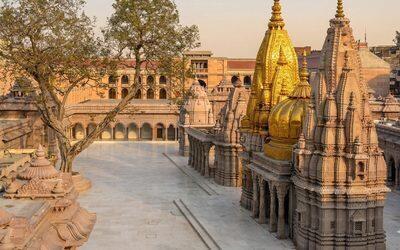
Lalita Devi at Naimisharanya is the heart-seat of Sati and the Devi in her supreme Tripura-Sundari form. Shakta tradition holds this Peetha among the most spiritually potent of all the 51 — the heart, in the body of the Goddess, is the seat of prema (divine love) and the inner-self; pilgrims approaching Lalita Devi are held to receive grace for the heart in all its forms — for love, for compassion, for the inward turning toward bhakti.
The Devi-bhakti tradition gives special weight to women-led worship at Shakti shrines, and Lalita Devi sees this in full: many of the temple's most beloved practices — the daily Lalita Sahasranama chanting, the Falgun Phulera Dooj rites, the Navaratri kanya-puja — are sustained by women devotees who hold the lineage of Devi-bhakti as their own. The temple is also the heart of the wider Naimisharanya tirtha: the Chakra Tirtha (the cosmic-wheel spot, a few hundred metres away), the Dadhichi Kund (where Sage Dadhichi gave his bones for Indra's vajra), and Hanuman Garhi all surround Lalita Devi, and a full Naimisharanya parikrama is held to be incomplete without darshan of the Devi at her heart-seat.
History
The Lalita Devi tradition at Naimisharanya is documented from antiquity — the Devi Bhagavata Purana and the Tantra Chudamani both name this Peetha in their listings of the 51 Shakti seats. Adi Shankaracharya, on his digvijaya tour of the Shakti Peethas, is held by tradition to have visited Lalita Devi Naimisharanya and praised the shrine; the Shankaracharya parampara of Devi-stuti has kept Lalita Devi in its canonical listings ever since. The present small stone-and-mortar shrine reflects multiple medieval rebuilds — the original ancient structure suffered through the medieval period and was rebuilt under local patronage; the present sanctum dates from successive Awadhi-period reconstructions. The temple has been continuously worshipped through every era despite its modest scale, sustained by the unbroken Devi-bhakti of the surrounding villages and the steady flow of Shakti-Peetha yatris from across India.
Architecture
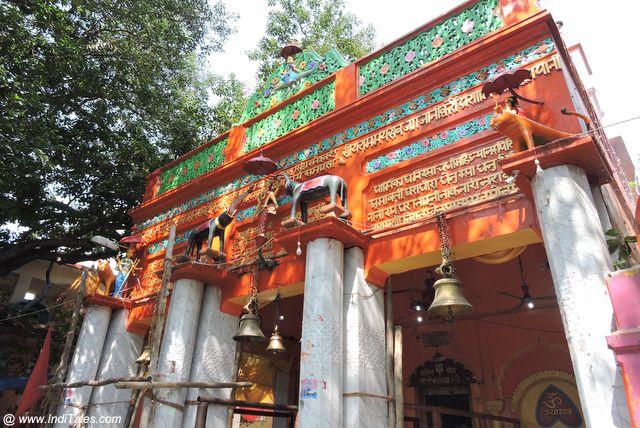
Lalita Devi Naimisharanya is a small stone-and-mortar shrine in regional Awadhi style — modest in architecture but spiritually significant beyond any measure of size. The principal sanctum is compact, with the Devi murti at the centre worshipped in the form of an ancient stone with vermilion, chunari, and floral offerings layered over generations of bhakti. A small mandap stands before the sanctum where the daily Lalita Sahasranama recitation takes place. The temple compound includes a small parikrama path and a tulsi platform; outer walls bear simple Awadhi-style decorative work. The compactness is itself part of the bhav — pilgrims describe the sense of standing close to the Devi's heart, the intimate proximity that the small shrine permits.
Rituals & Practices
The temple opens around 5:30 AM with the Mangala Aarti and closes around 9 PM with the Shayan Aarti; morning and evening aartis are the principal daily rituals. Throughout the day devotees chant the Lalita Sahasranama — the 1000-name hymn of the Goddess in her Tripura-Sundari form — continuously in groups inside the temple mandap; the unbroken Sahasranama chant is one of Lalita Devi's signature practices. Devotees offer chunari (red sari-cloth), bangles, vermilion, jasmine flowers, and sweets to the Devi. Many women-led groups conduct collective Sahasranama recitations and Devi-bhajan kirtans, especially on Tuesdays and Fridays.
The traditional Naimisharanya parikrama sequence: arrive at Naimisharanya, do darshan of Chakra Tirtha (the cosmic-wheel central tirtha), bathe in the Gomati, do darshan of Lalita Devi at her heart-seat, visit Dadhichi Kund (the bone-giving sage's spot) and Hanuman Garhi, and complete the parikrama. Many pilgrims combine Naimisharanya with Ayodhya or Lucknow in a longer Uttar Pradesh tirtha-yatra.
Festivals & Celebrations
| Festival | When | Crowd |
|---|---|---|
| Navaratri (Chaitra) | — | very_high |
| Navaratri (Sharad) | — | very_high |
| Falgun Phulera Dooj | — | high |
| Kartik Purnima | — | high |
Navaratri (Chaitra): The spring spiritual peak at the Shakti Peetha.
Navaratri (Sharad): The autumn supreme Devi-festival.
Falgun Phulera Dooj: The Naimisharanya region''s signature Devi-day.
Kartik Purnima: The Naimisharanya tirtha''s full-moon peak.
Prepare for Your Visit
Practical guidance to help you plan your pilgrimage
| Pilgrim Guidance | How to reachNaimisharanya is in Sitapur district, 95 km northwest of Lucknow (2.5 hours by road) and 42 km from Sitapur town. The nearest railway station is Naimisharanya itself (small station) and Sitapur Junction (well-connected to Lucknow, Lakhimpur, Hardoi). Lucknow airport is the nearest major airport. From Lucknow, regular buses, shared taxis, and private cars run to Naimisharanya; the temple is in the central tirtha-area, walkable from the main parikrama route. PreparationModest dress; women may wear a chunari to offer at the Devi. Carry vermilion, bangles, and jasmine flowers as the traditional Devi-offerings — available at small stalls around the temple. Phones permitted; photography of the murti restricted but outer-area is fine. Carry a printed Lalita Sahasranama if you wish to join the group recitation. Best time to visitOctober to March most pleasant. Navaratri (twice yearly — Chaitra in March-April and Sharad in September-October) is the supreme spiritual peak; the temple sees its largest flows during these nine-night Devi-festivals. Falgun Phulera Dooj (March) is the most beloved local festival. Kartik Purnima draws extra parikrama-yatris. |
Location
Sitapur, UP
Pilgrim photos
No pilgrim photos yet.
Community corrections
No corrections yet.
Edit history
No revisions yet.
Plan Your Visit to Lalita Devi Shakti Peeth, Naimisharanya
Get a custom itinerary and pricing for your trip.
Recommended
Packages for this destination
Pilgrim Notes
On-ground observations from fellow pilgrims
No pilgrim notes yet. Be the first to share on-ground observations!
Sign in to share a note.
Pilgrim Reviews
Be the first to share your experience at Lalita Devi Shakti Peeth, Naimisharanya.
Sign in to write a review.
Nearby sacred places
Discover other sacred places near Lalita Devi Shakti Peeth, Naimisharanya
Explore temples, tirthas, and pilgrimage sites in UP
Explore nearbyPart of these circuits
Walk the traditional pilgrimage routes this destination belongs to.