Madan Mohan is the senior thakur of the Vrindavan saptadevalaya and the deity of Sanatan Goswami — the eldest of the Six Goswamis of Vrindavan and the most senior disciple of Sri Chaitanya Mahaprabhu. The deity is small (about six inches), exquisitely carved, and tradition holds was discovered by Sanatan Goswami in the Yamuna river soon after his arrival in Vrindavan in the early 1530s.
The temple sits on a low hill on the western bank of the Yamuna, the highest point in old Vrindavan. The view from the temple terrace — the river curving below, the forest of Vrindavan stretching to the horizon — is held to be the most beautiful darshan-vista of Braj. The original mandir is built of red sandstone in Akbar-period Nagara style, with an 18-metre shikhara that remains visible from far across the Yamuna.
Katha — Sanatan Goswami and the Yamuna deity
Tradition tells that Sanatan Goswami, having renounced his ministerial position under Sultan Hussain Shah of Gauda, came to Vrindavan at the instruction of Sri Chaitanya Mahaprabhu to recover the lost tirthas of Krishna lila. He lived as a mendicant, sleeping under different trees each night, eating dry chapati begged from cowherd homes. One day a Yamuna fisherman is said to have brought him a small black-stone Krishna murti that had risen in his net; Sanatan Goswami recognised the deity as Madan Mohan — the form of Krishna who enchants the mind of Madana (Kamadeva) himself — and began worshipping him under a tree on the hill.
A second katha tells that the deity, lonely for proper seva, came to Sanatan Goswami in a dream and asked for a temple. Sanatan Goswami had nothing; he laughed and said that Madan Mohan must arrange his own temple. The deity then drew the Punjabi merchant Ram Das Kapoor of Multan to Vrindavan — Ram Das' grounded ship on the Yamuna was freed after he vowed to build the temple — and the great red-sandstone mandir was completed in 1580.
Madan Mohan is the principal seat of Sanatan Goswami's tradition — the eldest and most senior of the Six Goswamis of Vrindavan, and the bhakti-shastra authority of the Gaudiya world. Sanatan Goswami's Brihad-bhagavatamrita and Hari-bhakti-vilasa established the philosophical and ritual foundations of modern Gaudiya Vaishnavism. His samadhi is also at Vrindavan, a short walk from the Madan Mohan hill, and pilgrims traditionally visit both together.
Among the saptadevalaya, Madan Mohan is held to occupy the position of sambandha — the deity who establishes the devotee's relationship with Krishna. Govind Dev embodies abhidheya (the means), and Gopinath embodies prayojana (the goal). Together the three form the tattva-triad that Gaudiya tradition holds as the complete darshan-yatra of Vrindavan. Pilgrims who seek the order of the Six Goswamis typically begin at Madan Mohan and end at Radha Raman or Gopinath.
The deity is held to be especially merciful to those who have struggled with worldly attachment — Madana the mind-enchanter is himself enchanted by Krishna. Sanatan Goswami's lifelong renunciation makes the temple a refuge for those who seek to turn the mind inward.
History
The original deity was established by Sanatan Goswami in the early 1530s — soon after his arrival in Vrindavan from Bengal. Sanatan Goswami had been chief minister to Sultan Hussain Shah of Gauda before his renunciation; he was a learned man, deeply read in Sanskrit shastra, and the natural intellectual leader of the early Gaudiya mission to Vrindavan. He worshipped Madan Mohan as a mendicant for many years, with no temple structure beyond a thatched hut.
In about 1576 the Punjabi (Multan-region) merchant Ram Das Kapoor — drawn to Vrindavan after a dream in which Madan Mohan freed his grounded merchant ship on the Yamuna — vowed to build a grand temple from his trading profits. The construction took some four years; the temple was completed in 1580 and consecrated in the presence of the early Goswami community. The red-sandstone Akbar-period structure was, in its time, one of the most striking Vaishnava temples in north India.
In 1670, when Aurangzeb's persecution of Vrindavan temples reached its peak, the original Madan Mohan deity was carried out via Jaipur to Karauli in Rajasthan, where the Raja of Karauli received him as the family deity. The original murti remains at Karauli to this day, where he continues to be worshipped as the principal Madan Mohan of the tradition. A replica was later installed in the Vrindavan mandir for daily seva. Unlike Govind Dev — whose upper storeys were demolished — the Madan Mohan structure on the hill survived Aurangzeb's desecration largely intact, perhaps because of its remote hilltop location.
Architecture
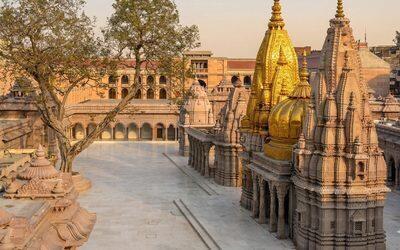
The Madan Mohan temple is built of red sandstone in Akbar-period Nagara style, with a tall 18-metre shikhara that rises from a stone plinth on the hilltop. The structure is a single jagamohan-and-sanctum unit — modest in floor area but striking in vertical proportion, with the shikhara curving inward in classic Nagara rekha-prasada form. The temple sits on the highest point of the old town and is visible from across the Yamuna.
The exterior is decorated with restrained Mughal-influenced arabesques alongside Vaishnava motifs — cow-bells, lotuses, and conches. The sanctum is small and dark, with a single image-throne; the original deity-niche remains, though the murti now worshipped is a replica of the Karauli original. The temple complex includes a small adjoining shrine for daily seva and a stone terrace from which the Yamuna and the forest of Vrindavan stretch into view.
Of the seven Vrindavan saptadevalaya temples, Madan Mohan is the one where the original Akbar-period architecture has best survived. The Archaeological Survey of India lists it as a protected monument; daily worship continues alongside conservation.
Rituals & Practices
Daily worship at Madan Mohan follows a simpler rhythm than the more elaborate seats at Govind Dev or Radha Raman: Mangala Arati around 5:30 AM, Sringar Darshan, Rajbhog and the midday pause, Sandhya Arati at dusk, and Shayan around 8:30 PM. The replica deity is dressed in seasonal silks and offered bhog cooked by the resident sevaks. Verify exact timings on arrival; they shift with the season.
The traditional yatra-sequence at Madan Mohan begins with the climb up the hill, then darshan at the sanctum, then a circumambulation of the temple, and finally a quiet pause on the terrace for the Yamuna view. Many pilgrims combine the visit with Sanatan Goswami's samadhi (a short walk away) and with the parikrama of the seven Vrindavan thakurs.
Festivals & Celebrations
| Festival | When | Crowd |
|---|---|---|
| Janmashtami | — | very_high |
| Sanatan Goswami Disappearance Day | — | high |
| Radhashtami | — | high |
| Phool Holi | — | very_high |
Janmashtami: The most important festival of the year for any Krishna temple.
Sanatan Goswami Disappearance Day: Founder''s day of the Madan Mohan tradition.
Radhashtami: Honours Radharani as the consort of Madan Mohan.
Phool Holi: The most beloved Braj festival of spring.
Prepare for Your Visit
Practical guidance to help you plan your pilgrimage
| Pilgrim Guidance | How to reachMadan Mohan is on a hill on the western edge of old Vrindavan, near the Kali-deha ghat of the Yamuna. From the parikrama-marg, e-rickshaws drop pilgrims at the base of the hill; the climb to the sanctum is about 5-7 minutes on stone steps. Mathura Junction (12 km) is the railhead; Delhi (150 km) the nearest airport. PreparationModest dress; full-sleeved kurtas and full-length lower garments. The stone steps to the hill can be hot in summer afternoons — carry a small cloth for the feet or come in the early morning. Carry water, especially in summer. Photography is permitted in the outer courtyard and on the terrace (excellent views) but not in the sanctum. Best time to visitOctober to March for pleasant weather. Janmashtami, Sanatan Goswami Disappearance Day (Ashadha Krishna), Radhashtami, and Phool Holi are the major occasions. Early morning Mangala Arati is the spiritual peak of the day, and the terrace at sunrise — with the Yamuna mist rising below — is among the most beautiful darshans in all of Braj. |
Location
Mathura, UP
Pilgrim photos
No pilgrim photos yet.
Community corrections
No corrections yet.
Edit history
No revisions yet.
Plan Your Visit to Madan Mohan Temple
Get a custom itinerary and pricing for your trip.
Recommended
Packages for this destination
Pilgrim Notes
On-ground observations from fellow pilgrims
No pilgrim notes yet. Be the first to share on-ground observations!
Sign in to share a note.
Pilgrim Reviews
Be the first to share your experience at Madan Mohan Temple.
Sign in to write a review.
Nearby sacred places
Discover other sacred places near Madan Mohan Temple
Explore temples, tirthas, and pilgrimage sites in UP
Explore nearbyPart of these circuits
Walk the traditional pilgrimage routes this destination belongs to.