Mor Kuti — the "peacock-hut" — is one of the most cherished lila-sthalis of Barsana, the hill-town of Sri Radha. It stands on the wooded slope of Brahmagiri, the sacred ridge whose four peaks are revered as the four faces of Brahma offering eternal darshan to the Yugal Sarkar. The shrine itself is modest: a small kunj enclosed by stone walls, opening into a quiet courtyard where peacocks still gather at dawn, and a sanctum where Radha and Krishna are worshipped in their playful mor-lila form.
For the people of Braj, Mor Kuti is not approached as an architectural site but as a living memory. It is the kunj where, according to the rasik tradition, Krishna once chose to enchant Radha not as a flute-player or as a cowherd, but as a peacock — dancing for her with feathers spread, circling her in slow joy, while the gopis watched from behind the trees and laughed. The katha is sung at almost every Barsana samaj-gayan, and the courtyard at Mor Kuti is felt by pilgrims to be that very ground.
Katha — the peacock-dance for Radha
Tradition holds that one afternoon Krishna came alone to Barsana, longing to delight Radha in a way she had never seen. He saw the peacocks of Brahmagiri dancing in the monsoon clouds — their feathers fanned wide, their tread soft and rhythmic — and a thought arose in him. Taking the form of a peacock himself, he entered the kunj where Radha sat with her sakhis, and began to dance. The sakhis recognised him at once and pressed their hands to their mouths in laughter. Radha alone watched in silent wonder, then bent down, picked up a single peacock feather that had fallen from his dance, and placed it gently in his hair as he returned to his own form. The rasiks sing of that peacock-dance with tender delight.
A second katha, beloved of the Nimbarka sampradaya, tells that Radha herself once asked Krishna why peacocks dance with such abandon. Krishna, smiling, said that they dance because they have seen what no one else has seen. When Radha pressed him, he disguised himself and danced for her in the form of a peacock — a lila that, in the rasik understanding, is the gift of Radha's loving curiosity.
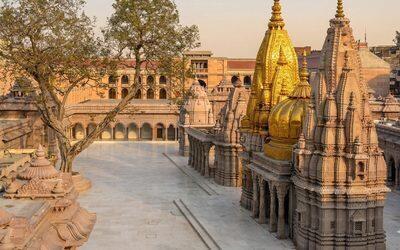
Mor Kuti is one of the principal lila-sthalis of Barsana — the place where Krishna's bhav of pleasing Radha takes its sweetest visible form. In the rasa-marga of the Ashtachhap poets and the Radhavallabha, Nimbarka, and Gaudiya sampradayas, the mor-lila is understood as a teaching: that the lover takes whatever form the beloved finds delightful, and that even Krishna, the source of all beauty, will adorn himself for the eyes of Sri Radha alone. Pilgrims who come to Mor Kuti are said to be drawn into this seva-bhav — the desire to delight the divine rather than only to receive from it.
Mor Kuti is also revered as a kunj of vrindavani ras-leela — the broader Braj tradition of leela-smaran in which the rasa-dance and its many sakha-lilas are remembered through song, dance, and silent contemplation. The Barsana priests preserve a samaj-gayan tradition in which the mor-lila is sung on Phulera Dooj, on Radhashtami, and especially in the days leading up to the Lathmar Holi, when Barsana itself becomes a kunj of song. Pilgrims who climb to Mor Kuti during these days often hear the lila being sung in the courtyard itself, the bhajan rising up the hillside with the morning mist.
This kunj is held by the rasiks to carry within it the entire memory of that peacock-lila. To see Krishna anywhere — at Banke Bihari, at Govind Dev, at Madan Mohan — is to see the feather Radha placed; and to come to Mor Kuti is, in turn, to touch the source of that feather. For this reason the small shrine is loved out of all proportion to its size.
History
The kunj of Mor Kuti is held by Braj tradition to be ancient — one of the lila-sthalis recovered by the Goswamis and rasik acharyas of the sixteenth century during the great rediscovery of the Braj-bhumi that followed the arrival of Sri Chaitanya Mahaprabhu, Vallabhacharya, and Sri Hit Harivansh in the region. The site itself, like much of Barsana hill, was identified through local oral tradition, sung katha, and the inner guidance of the bhakti acharyas; pilgrims who came afterwards built and rebuilt the small shrine over the centuries.
The present structure dates largely from the rebuilding patronage of the Bhaktamal-period and later Jaipur-Bharatpur Vaishnava patrons, who supported the smaller Barsana kunjs alongside the great Shri-ji temple on the hilltop. The shrine has been maintained in unbroken seva by the local Goswami families, who continue the daily worship and the seasonal samaj-gayan of the mor-lila. Restoration work in recent decades has stabilised the stone walls and protected the inner sanctum, while preserving the simple, kunj-like character of the place.
Unlike the larger Braj temples, Mor Kuti has never been wealthy. It is loved not for grandeur but for atmosphere — the trees, the peacocks, the cool stone of the courtyard, and the unbroken devotional memory of the lila it holds.
Architecture
Mor Kuti is built in the typical kunj-style of the small Barsana lila-sthalis — a single-room sanctum enclosed by low stone walls, a modest stone gateway, and an open inner courtyard shaded by old trees. There is no shikhara of the grand temple kind; the roof is flat-stoned and topped only by a small kalasha. The sanctum holds Radha-Krishna in their mor-lila darshan: Krishna stands in a gentle dancing posture with peacock-feather-painted shringar, and Radha stands beside him with a single feather held in her hand. The deities are dressed daily by the Goswami sevaks in soft silks coloured to the season.
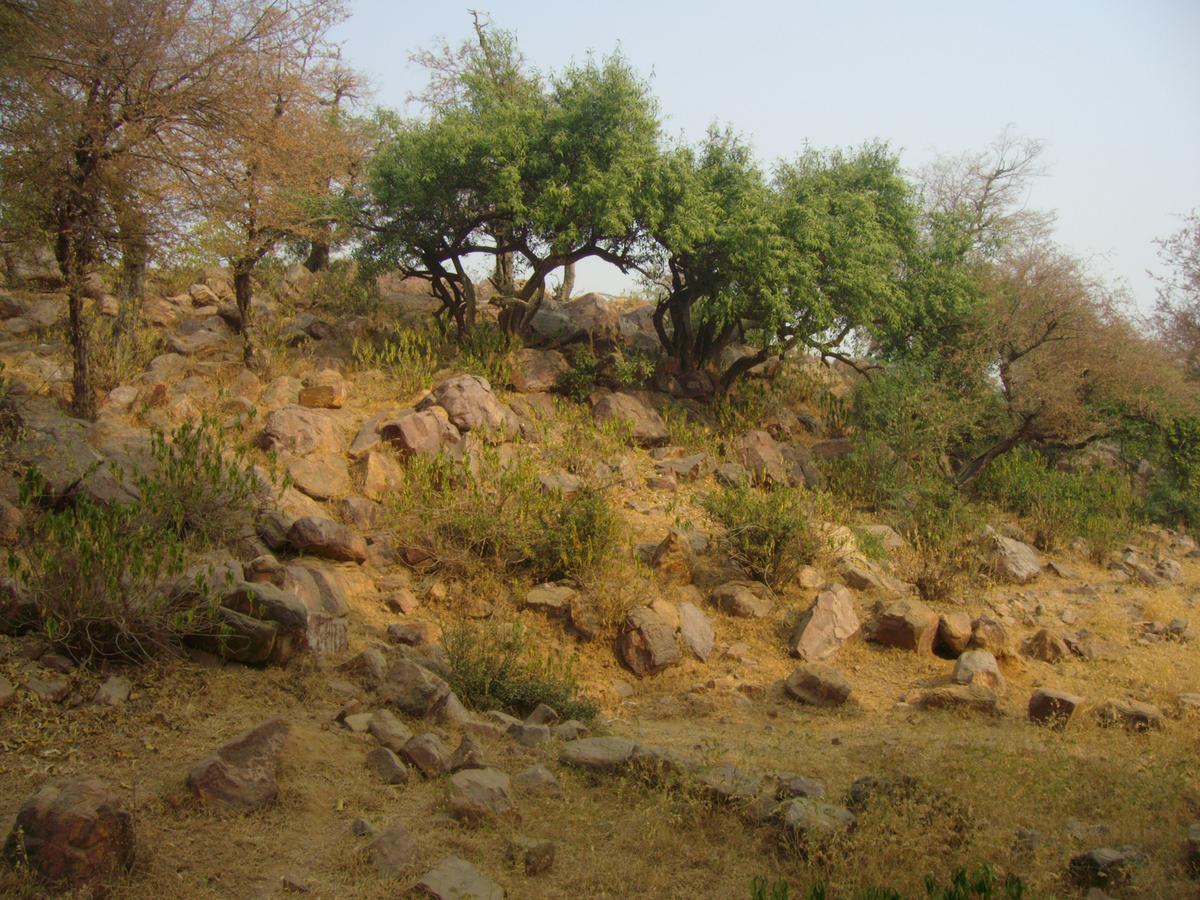
The courtyard is the heart of the shrine. Old jamun and pipal trees rise above the stone walls, and peacocks — descendants, the priests say, of the peacocks of the lila itself — gather here at dawn and dusk. A small platform along one wall is used for samaj-gayan during festivals; the rest of the courtyard is open ground, swept clean each morning. From a high spot at the edge of the courtyard, one can see across to the Shri-ji temple on the next ridge of Brahmagiri.
Rituals & Practices
Daily seva at Mor Kuti follows the simple kunj-style rhythm of the small Barsana shrines: Mangala Arati before dawn, Sringar Darshan in the early morning, Rajbhog around midday, Sandhya Arati at dusk, and Shayan in the evening. Exact timings are kept by the Goswami sevaks and shift seasonally; pilgrims should verify on arrival. The bhog is prepared daily in the kunj kitchen and offered in cowherd-style — milk, butter, simple sweets, and seasonal fruit — in keeping with the playful mor-lila bhav of the deity.
The shrine is most beloved during samaj-gayan — the seasonal devotional singing tradition of Barsana — when the local priests and pilgrims gather in the courtyard to sing the mor-lila pad of the Ashtachhap and the Radhavallabha and Nimbarka acharyas. Mangala and Sringar are quiet and intimate; samaj-gayan brings the courtyard alive with bhajan and the soft response of peacock calls from the trees. Pilgrims often sit through an entire round of samaj-gayan, even when they cannot follow every word of the Braj-bhasha pad.
Festivals & Celebrations
| Festival | When | Crowd |
|---|---|---|
| Lathmar Holi | — | very_high |
| Radhashtami | — | very_high |
| Phulera Dooj | — | high |
| Shravan Hindola | — | medium |
Lathmar Holi: The most celebrated festival of Barsana; mor-lila pad are sung throughout.
Radhashtami: The most sacred day of the year at Barsana â the birthday of Radharani, soul of the mor-lila.
Phulera Dooj: The traditional Braj opening of the spring-leela season.
Shravan Hindola: The monsoon season most closely connected with the mor-lila of Krishna.
Prepare for Your Visit
Practical guidance to help you plan your pilgrimage
| Pilgrim Guidance | How to reachMor Kuti is on the slope of Brahmagiri hill in Barsana, a short walk from the main Shri-ji temple parikrama path. Barsana itself is about 50 km from Mathura by road and about 25 km from Govardhan; shared autos and e-rickshaws run from Barsana market to the base of the hill. From the base, the climb to Mor Kuti is gentle — about 10–15 minutes on stone steps shaded by old trees. Mathura Junction is the railhead; Delhi (140 km) the nearest airport. PreparationModest dress — full-sleeved kurtas and full-length lower garments are appropriate for Barsana, which keeps a more traditional code than Vrindavan town. The stone steps can be hot in summer afternoons; come in the early morning or in the cooler evening hours. Carry water. Photography is restricted near the deity but allowed in the outer courtyard, where the peacocks and the view to Shri-ji are especially beautiful. Best time to visitOctober to March for comfortable weather. The shrine takes on its most spiritually charged atmosphere during Lathmar Holi (Phalguna Shukla Navami), Phulera Dooj, Radhashtami, and the monsoon weeks of Shravan, when the peacocks dance most beautifully and the mor-lila feels closest. The broader Braj parikrama tradition links Mor Kuti with Sankari Khor, Sanket, and the Shri-ji temple as the core Barsana kunjs. |
Location
Mathura, UP
Pilgrim photos
No pilgrim photos yet.
Community corrections
No corrections yet.
Edit history
No revisions yet.
Plan Your Visit to Mor Kuti
Get a custom itinerary and pricing for your trip.
Recommended
Packages for this destination
Pilgrim Notes
On-ground observations from fellow pilgrims
No pilgrim notes yet. Be the first to share on-ground observations!
Sign in to share a note.
Pilgrim Reviews
Be the first to share your experience at Mor Kuti.
Sign in to write a review.
Nearby sacred places
Discover other sacred places near Mor Kuti
Explore temples, tirthas, and pilgrimage sites in UP
Explore nearbyPart of these circuits
Walk the traditional pilgrimage routes this destination belongs to.