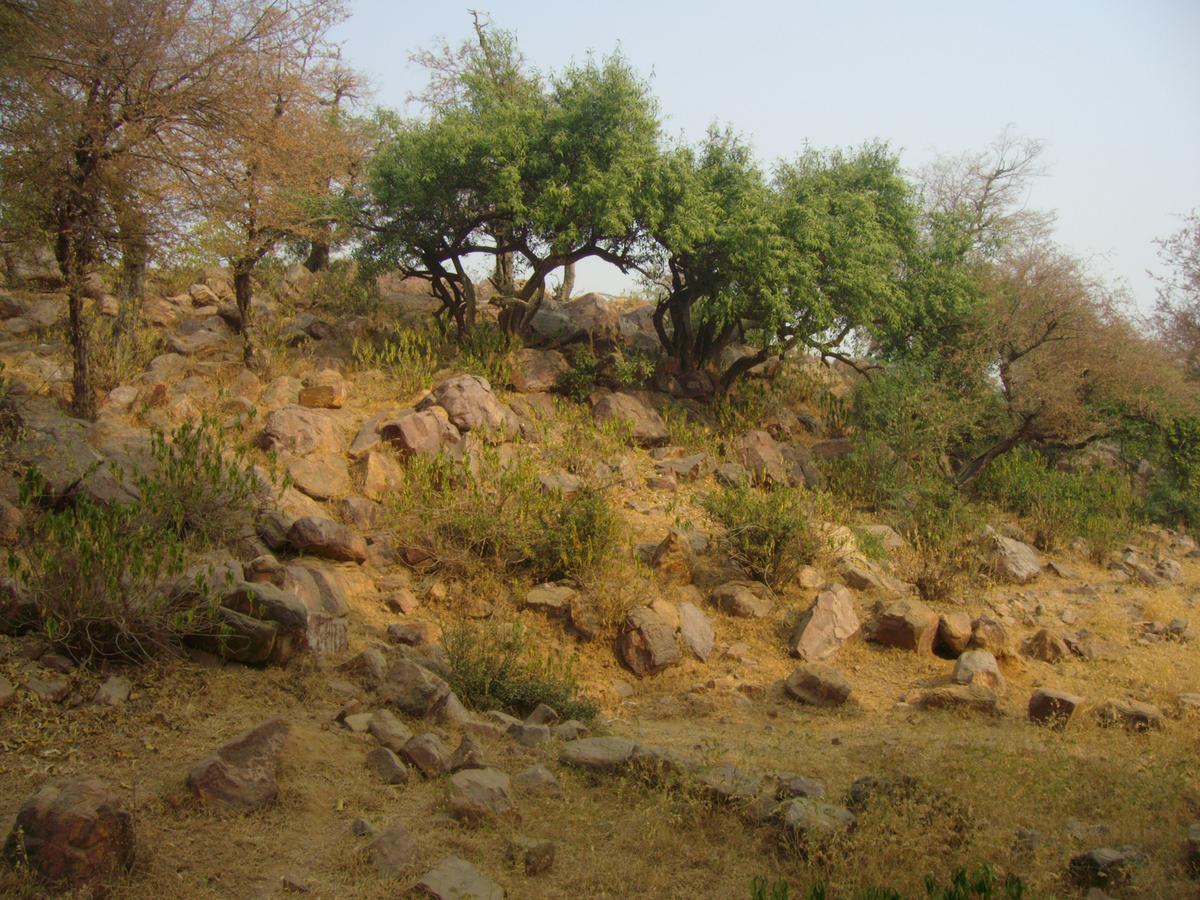
Nidhivan is among the most secretive and beloved tirthas of Vrindavan. The grove sits in old Vrindavan, a short walk from the Banke Bihari Temple and Radha Raman, hidden behind plain walls that give no hint of the mystery within. Inside, low Tulsi bushes and small Krishna-leaf trees grow in twisted, intertwined forms; tradition holds that each pair of trees is one of the gopis and her sakhi, frozen in plant form so they may remain in Vrindavan to witness the nightly ras-lila.
The grove is the place where Swami Haridas — the great Vaishnava saint and the teacher of Tansen — sang his bhajans through the sixteenth century. Tradition tells that as Haridas sang, Radha and Krishna appeared together before him; on his request that they remain in worshipable form, the two divine beings merged into the murti now worshipped at the Banke Bihari Mandir. A small shrine within Nidhivan marks the exact spot of the appearance, and a Banke Bihari deity is housed there as well — kept in the grove rather than the main temple.
The mystery of the nightly ras
The most deeply held tradition of Nidhivan is that Radha-Krishna perform their nightly maha-ras here, and that no living being may witness it. The small Banke Bihari shrine within the grove holds the deity who joins the lila each night. The temple keepers prepare the deity's bed before the Shayan Arati at sunset, leave fresh water, milk, and a betel-leaf, and lock the grove. The next morning at Mangala Arati, the bed shows signs of having been slept in, the betel-leaf is chewed, and the water and milk are partially gone. Tradition further holds that any monkey, peacock, or human who enters during the night becomes blind, mad, or mute — the warning is taken seriously and the grove is sealed from sunset to dawn.
Nidhivan is held by the Haridasi Sampradaya — the lineage founded by Swami Haridas — to be the supreme seat of Madhurya-bhakti (the bhakti of conjugal sweetness). The teaching is that in Vrindavan, Radha-Krishna are eternally present in their nikunja-lila; pilgrims who come with the right bhav can sometimes feel their presence even during the daytime, in the play of light through the twisted Tulsi forms and in the silence of the grove.
The grove is one of the few places in Vrindavan where the tradition itself prevents excessive pilgrim flow — no one stays inside for long, no commercial activity is permitted within, and the boundaries are clearly marked. Even seasoned Vrindavan-vasi devotees consider a single quiet visit to Nidhivan a complete darshan; speaking too much, photographing, or trying to verify the night-lila is seen as inappropriate.
History
Nidhivan's history reaches into the very beginnings of modern Vrindavan as a pilgrim centre. Swami Haridas (1480-1573) settled at Nidhivan in the early sixteenth century, after the rediscovery of Vrindavan by Sri Chaitanya Mahaprabhu and the Six Goswamis. Haridas was a contemporary of Tansen — tradition holds that Tansen accompanied Akbar to Vrindavan to hear Haridas sing, and that Akbar himself was moved by the bhajan he heard at this very grove.
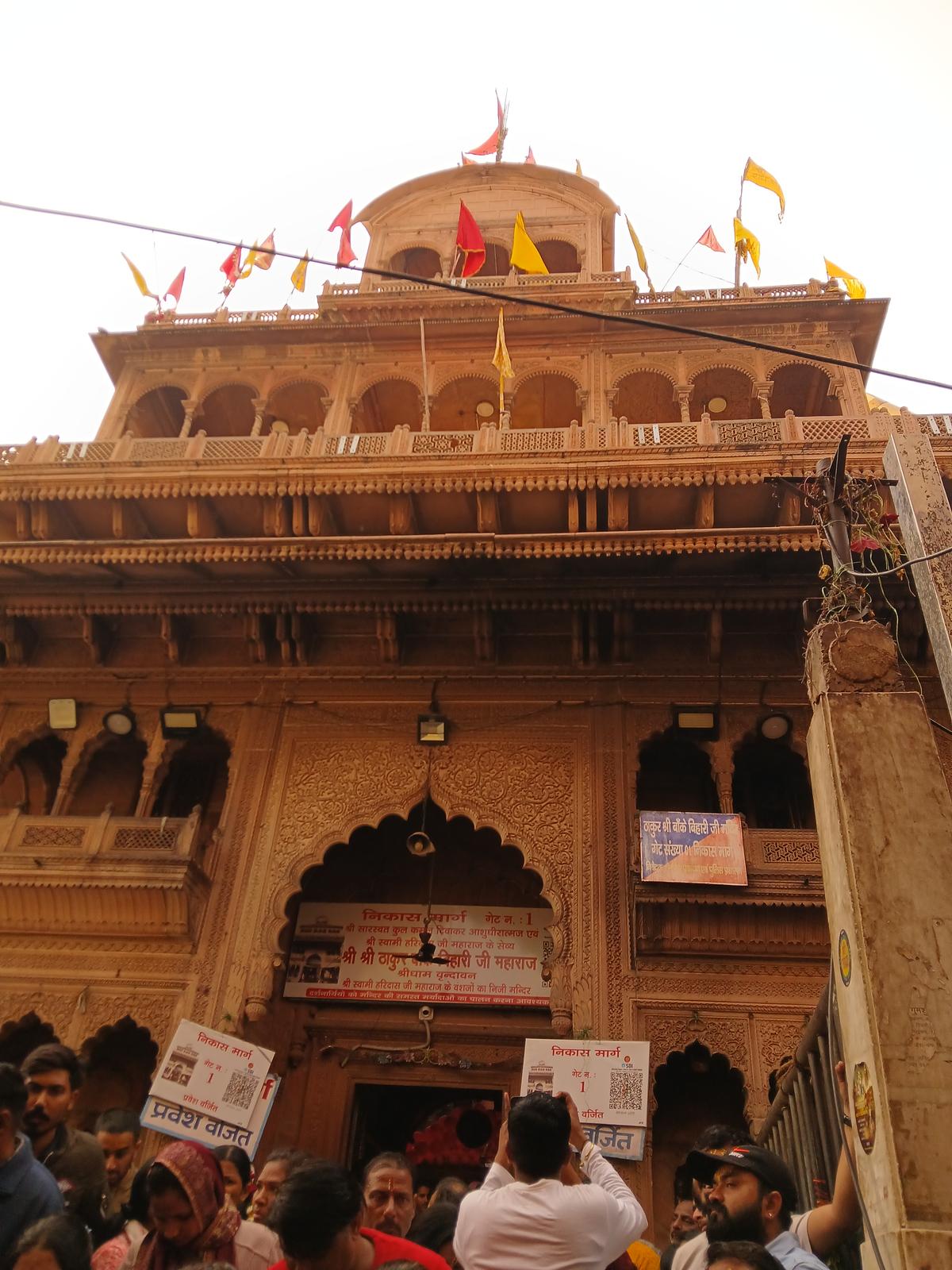
The Banke Bihari Mandir was built only in 1864, when the descendants of Haridas moved the principal deity out of Nidhivan and into a proper temple a short distance away. The replica Banke Bihari at Nidhivan continues to be served by the Goswamis, and the grove itself is protected by the Nidhivan Trust under the supervision of the Banke Bihari Mahanta.
Architecture
Nidhivan is not a constructed shrine but a natural grove preserved over five centuries. The grove covers about 2 hectares of low Tulsi and small-leaved Krishna trees that have grown intertwined and stunted — none rise higher than a small adult. The walls around the grove are plain plastered stone; entry is through one small gate. A short stone path leads to the central shrine — the Bhog Mandir of Banke Bihari Ji — where the deity who joins the night-lila is housed.
Within the grove are several small subsidiary shrines: the Rang Mahal (the chamber where the deity rests), the Vyasa Gaddi, and small samadhi-sthals of Haridasi acharyas. The atmosphere is intimate, hushed, and deeply old.
Rituals & Practices
Nidhivan opens around 6 AM and closes after the Shayan Arati at sunset. The grove is locked from sunset to sunrise; no one — pilgrims, sadhus, or temple keepers — enters during the night. The temple opens again at Mangala Arati when the bed of Banke Bihari Ji is found in the morning showing signs of use, and the day's seva begins.
The traditional sequence at Nidhivan is silent — speak only in whispers if at all, walk gently, do not photograph inside the grove (signs are posted), and let the grove's silence work on the heart. Many pilgrims sit quietly for some time on the stone benches near the entrance, then move to Banke Bihari for darshan. Together, Nidhivan and Banke Bihari are considered the complete darshan of the Haridasi tradition.
Festivals & Celebrations
| Festival | When | Crowd |
|---|---|---|
| Sharad Purnima | — | very_high |
| Janmashtami | — | very_high |
| Sri Haridas Pragatya | — | high |
| Daily Mangala Arati | — | moderate |
Sharad Purnima: The supreme night of the ras-lila in Vrindavan tradition.
Janmashtami: Krishna''s appearance day.
Sri Haridas Pragatya: Honours the founder of the Haridasi Sampradaya.
Daily Mangala Arati: The continuing miracle of Nidhivan.
Prepare for Your Visit
Practical guidance to help you plan your pilgrimage
| Pilgrim Guidance | How to reachNidhivan is in old Vrindavan, a 5-minute walk from Banke Bihari Mandir. From the parikrama-marg, e-rickshaws drop pilgrims at the gali entrance. Mathura Junction (12 km) is the railhead. PreparationModest clothes; full-sleeved kurtas. Footwear off at the entrance. Photography is strictly forbidden inside the grove — signs are posted in multiple languages. Best time to visitEarly morning (just after the grove opens) is the most peaceful and traditional time. Avoid the post-arati rush at Banke Bihari, which can spill over to Nidhivan. Sharad Purnima (Ashwin Purnima, the maha-ras-night) is the spiritual peak. |
Location
Mathura, UP
Pilgrim photos
No pilgrim photos yet.
Community corrections
No corrections yet.
Edit history
No revisions yet.
Plan Your Visit to Nidhivan
Get a custom itinerary and pricing for your trip.
Recommended
Packages for this destination
Pilgrim Notes
On-ground observations from fellow pilgrims
No pilgrim notes yet. Be the first to share on-ground observations!
Sign in to share a note.
Pilgrim Reviews
Be the first to share your experience at Nidhivan.
Sign in to write a review.
Nearby sacred places
Discover other sacred places near Nidhivan
Explore temples, tirthas, and pilgrimage sites in UP
Explore nearbyPart of these circuits
Walk the traditional pilgrimage routes this destination belongs to.