Patalpuri Mandir rests within the historic compound of the Allahabad Fort at Prayagraj, close to the holy confluence of the Ganga, Yamuna and the unseen Saraswati. Unlike the open shrines of the ghats and the river-banks, Patalpuri is reached by descending into the earth — a vaulted underground chamber lit by oil-lamps, its low stone pillars worn smooth by the touch of countless pilgrims. The very name, Patalpuri, means "the city beneath the earth," and the bhav of the place is unmistakable: an antiquity older than any visible structure, a quietness held inside the rock itself.
Pilgrim tradition, drawn from the Prayag Mahatmya of the Puranas and from continuous oral memory, holds that Bhagavan Sri Rama, during his fourteen-year vanvas, came to Prayag with Sita Devi and Lakshman Ji to receive the darshan of Maharishi Bharadwaj, whose ashram stood close by. From there, the tradition continues, Sri Rama descended into this very precinct to honour the deities of patala and to take darshan of the Akshayavat — the imperishable banyan whose roots, the Puranas say, reach into the lower worlds and whose branches remain unwithered through the ages.
Within the underground chamber stand many small murtis arranged along the rock walls — Sri Rama, Sita, Lakshman, Hanuman, Shiva in linga-form, Yama, the navagraha, and the rishis. Pilgrims move slowly through the low passage, bowing at each shrine, the air cool against the skin even when summer burns above. At the heart of the larger compound rises the Akshayavat, the immortal banyan, sheltered today within a stone enclosure and honoured by devotees with circumambulation, prayer and the offering of red cloth.
The katha of Prayag and Sri Rama's visit
The Puranas praise Prayag as Tirtharaj, the king of all tirthas, the sangam where three sacred rivers meet and where the very ground is held to be hallowed by Brahma's first yajna. The Prayag Mahatmya describes Sri Rama's journey: leaving Ayodhya in observance of his father's word, the prince approached the ashram of Maharishi Bharadwaj at the meeting of the rivers. After receiving the rishi's blessing and counsel for the road ahead, tradition holds that Sri Rama came to the sacred precinct that today bears the Patalpuri shrine, bowing at the immortal banyan and to the deities of the underworld before continuing toward Chitrakoot. For Vaishnava pilgrims, this bhav — of standing where Sri Rama himself stood, of bowing where Maryada Purushottam bowed — gives Patalpuri its quiet, unforgettable weight.
The Akshayavat
The Akshayavat, the imperishable banyan, is honoured in the Puranas as one of the eternal trees of Bharatavarsha. The Padma Purana and the Matsya Purana describe it as the tree which remains unwithered through the cycles of pralaya, beneath whose shade the great rishis once sat. Pilgrims at Prayag have honoured the Akshayavat for ages — the Chinese traveller-monk Xuanzang, who came to Prayag in the seventh century, recorded the sacred tree in his account, calling it the tree from which devotees of the time offered themselves in supreme renunciation. Today access to the Akshayavat is gentle and devotional: a short walk through the fort compound, a bow at the enclosure, the offering of red cloth and prayer.
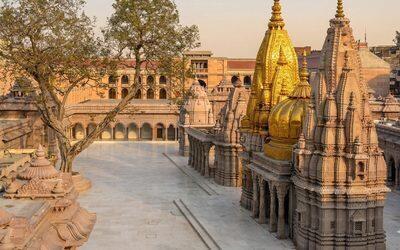
Patalpuri Mandir carries the rare bhav of a tirtha that has remained sacred through every age of Bharatavarsha. The temple is honoured for three intertwined reasons. First, it is held in tradition to be the very precinct visited by Bhagavan Sri Rama during his vanvas — a darshan here is therefore felt as a darshan of the ground that received the feet of Maryada Purushottam. Second, the underground form itself is a tirtha of patala, the lower worlds; devotees bow here to Yama, the navagraha, and the deities of the underworld, seeking their blessing and the easing of ancestral karma. Third, the precinct holds the Akshayavat, the imperishable banyan praised across the Puranas, whose darshan is held to bestow imperishable merit.
For Vaishnava pilgrims, the link with Sri Rama gives Patalpuri its devotional heart; for the smarta tradition, the underground shrines and the Akshayavat together make this one of the foundation-tirthas of Prayag Mahatmya. Many pilgrims who come for the great Sangam-snan also undertake Patalpuri darshan as the inward completion of their Prayag yatra — the bath in the rivers, followed by the descent to the older shrines of the earth, followed by the bow before the imperishable tree. The Padma Purana, Matsya Purana, the Prayag Mahatmya and Tulsidas's Ramcharitmanas all carry references that pilgrim tradition has attached to this precinct.
History
The antiquity of Patalpuri reaches into ages beyond constructed history. Puranic tradition holds the shrine to have existed from time immemorial, sanctified by the visit of Sri Rama and by the presence of the Akshayavat. The Chinese traveller-monk Xuanzang, who visited Prayag in the seventh century during the reign of Harshavardhana, has left a careful record of the sacred tree at this location, confirming the shrine's recognition in the early medieval period.
The present masonry enclosure and the surrounding fort were raised by Emperor Akbar in the late sixteenth century, when the great fort of Allahabad was constructed at the confluence. The Patalpuri shrine and the Akshayavat, already sacred for centuries, were brought within the new fort walls; pilgrim access continued through the long Mughal and British periods, and continues today under the joint stewardship of the Archaeological Survey of India and the Indian Army, which manages the fort. Pilgrim records from the seventeenth century onward describe Patalpuri as one of the indispensable darshans of the Prayag yatra. The shrine has been continuously worshipped through the changes of empire, the floods of the rivers, and the great Kumbh gatherings of every twelve years.
Architecture
Patalpuri is structurally unique among the temples of Prayag. There is no rising shikhara, no visible mandapa above the earth; the entire shrine lies beneath the surface, accessed by a descending stone passage. The chamber is low-ceilinged, vaulted in stone, supported by rows of square pillars worn smooth by the touch of pilgrim hands over the centuries.
The murtis are arranged along the walls in many small niches — Sri Rama with Sita Devi and Lakshman Ji, Hanuman Ji in attendance, Shiva in linga-form, the Devi in several forms, Yama and the navagraha, and the great rishis of the Vedic tradition. Oil-lamps and small clay deepaks light the chamber. The atmosphere is cool, hushed and devotional, untouched by the noise of the outer fort.
Outside the underground chamber, within the wider fort compound, stands the Akshayavat — the imperishable banyan — sheltered within a stone enclosure with steps and a small pradakshina path. The compound also holds the Saraswati Koop, a small ancient well held to draw waters from the unseen Saraswati. Banyan, pipal and ashok trees shade the precinct, and the great walls of the Akbari fort rise around it.
Rituals & Practices
The traditional darshan-sequence at Patalpuri: pilgrims first take snan at the Triveni Sangam, then proceed to the Allahabad Fort compound. Entry to Patalpuri and the Akshayavat is granted at fixed visiting hours through a designated gate (currently arranged by the Indian Army together with the temple administration). Pilgrims remove footwear at the entrance, descend the stone passage into the underground chamber, and bow at each of the many small murtis as they move slowly along the vault.
After the Patalpuri darshan, the pilgrim emerges into the sunlit compound and walks to the Akshayavat enclosure, where the immortal banyan is honoured with circumambulation, prayer, and the offering of red cloth, flowers or coconut. Many pilgrims also offer a small donation toward the upkeep of the shrine. The Saraswati Koop is honoured nearby. Daily aarti is performed within the chamber at the customary hours; recitation of the Ramcharitmanas, the Hanuman Chalisa, and verses from the Prayag Mahatmya is a long-standing devotional practice here.
For pilgrims completing the wider Prayag yatra, Patalpuri darshan is traditionally combined with the Sangam-snan, darshan at the Bade Hanuman ji (Lete Hue Hanuman) temple nearby, Mankameshwar Mandir, and the Bharadwaj Ashram across the Yamuna.
Festivals & Celebrations
| Festival | When | Crowd |
|---|---|---|
| Magh Mela | — | very_high |
| Kumbh Mela | — | very_high |
| Ram Navami | — | high |
| Kartik Purnima | — | high |
| Daily | — | moderate |
Magh Mela: The annual mela of Prayag; the month held in the Puranas to bestow special merit on those who bathe and worship at the sangam.
Kumbh Mela: The supreme tirtha-gathering, held in tradition to mark the days when the nectar of immortality is closest to the waters of the sangam.
Ram Navami: The day of Maryada Purushottam's appearance.
Kartik Purnima: A great bath-day of the Hindu calendar.
Daily: The continuous flow of the Prayag pilgrim-tradition.
Prepare for Your Visit
Practical guidance to help you plan your pilgrimage
| Pilgrim Guidance | How to reachPatalpuri Mandir is within the Allahabad Fort compound at Prayagraj, on the southern bank of the Yamuna at the confluence. The nearest railway stations are Prayagraj Junction (4 km) and Prayagraj Rambagh; Prayagraj Airport is 15 km. The fort is walkable from the Sangam ghats; auto-rickshaws and e-rickshaws are easily available from any part of the city. Visiting hours and entryPatalpuri and the Akshayavat are within the operational Allahabad Fort, which is managed by the Indian Army. Public access is granted only during specified hours through a designated pilgrim gate. Hours and arrangements can change with security requirements and during the Kumbh and Magh Mela periods; pilgrims should confirm current timings locally before visiting. Carrying of identity proof is helpful. Photography inside the underground chamber is generally restricted. PreparationModest dress; head covering for women is appreciated. Carry a small offering of flowers, red cloth or fruit. The descent into the chamber requires care — the steps are old, the passage is low, and the floor can be uneven. Pilgrims with mobility difficulties should plan accordingly. Many devotees combine Patalpuri darshan with the Triveni Sangam snan in a single morning; the wider Prayag parikrama, including Bharadwaj Ashram, takes a full day. Best time to visitOctober to March is the most pleasant season at Prayagraj. Magh Mela (mid-January to mid-February) brings vast pilgrim flow to the Sangam, and many Magh Mela pilgrims undertake Patalpuri and Akshayavat darshan as part of their stay. The Kumbh Mela (every twelve years, with the Ardh Kumbh every six years) brings the greatest gathering of all. Ram Navami (March-April) is observed with special bhav at the Patalpuri shrine. |
Location
Prayagraj, UP
Pilgrim photos
No pilgrim photos yet.
Community corrections
No corrections yet.
Edit history
No revisions yet.
Plan Your Visit to Patalpuri Mandir, Prayagraj
Get a custom itinerary and pricing for your trip.
Recommended
Packages for this destination
Pilgrim Notes
On-ground observations from fellow pilgrims
No pilgrim notes yet. Be the first to share on-ground observations!
Sign in to share a note.
Pilgrim Reviews
Be the first to share your experience at Patalpuri Mandir, Prayagraj.
Sign in to write a review.
Nearby sacred places
Discover other sacred places near Patalpuri Mandir, Prayagraj
Explore temples, tirthas, and pilgrimage sites in UP
Explore nearbyPart of these circuits
Walk the traditional pilgrimage routes this destination belongs to.