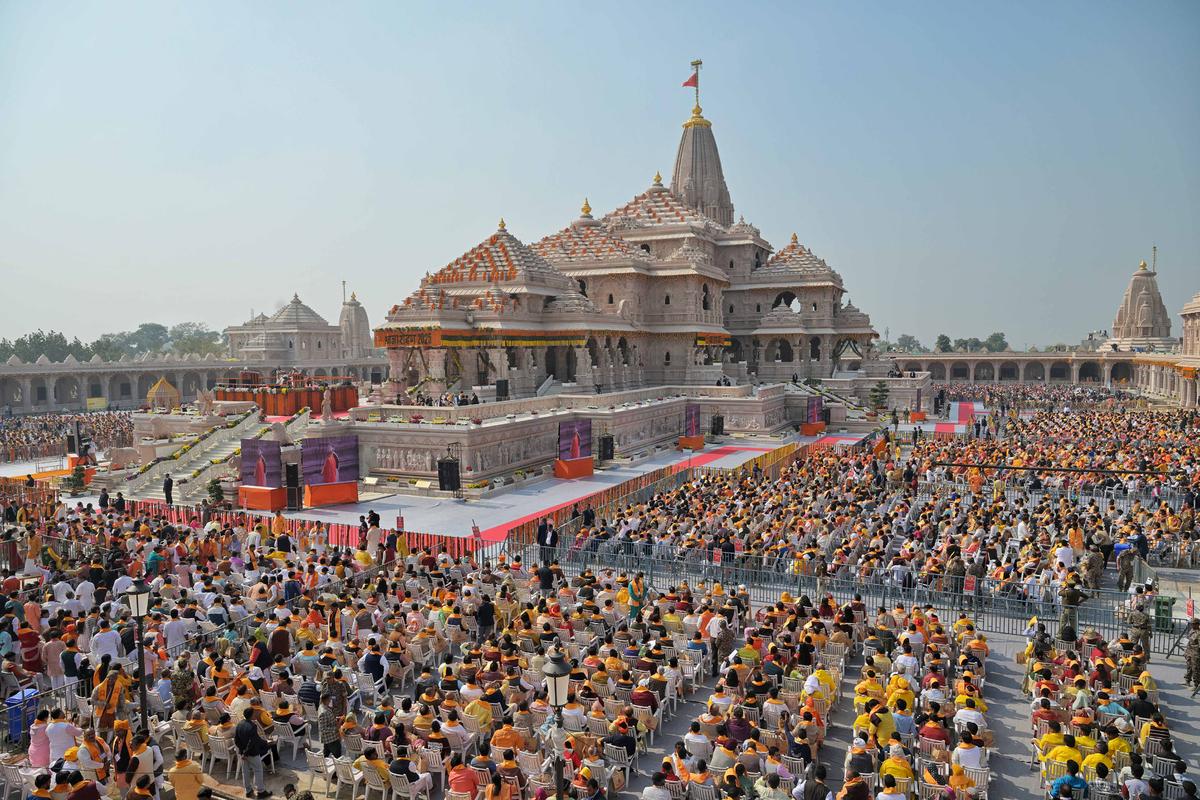
The Shri Ram Janmabhoomi mandir is approached as the fulfilment of a long-cherished devotional aspiration of Sanatan Dharma. The murti of Ram Lalla — Bal Roop, the child form of Ram — was sculpted by Arun Yogiraj of Mysuru from Krishna-Shaila black stone and consecrated through Vedic Pran Pratishtha rites on 22 January 2024 by the Acharyas appointed by the Shri Ram Janmabhoomi Teerth Kshetra Trust. The ceremony was presided over by the Prime Minister of India and attended by saints, devotees, and dignitaries from across Bharat.
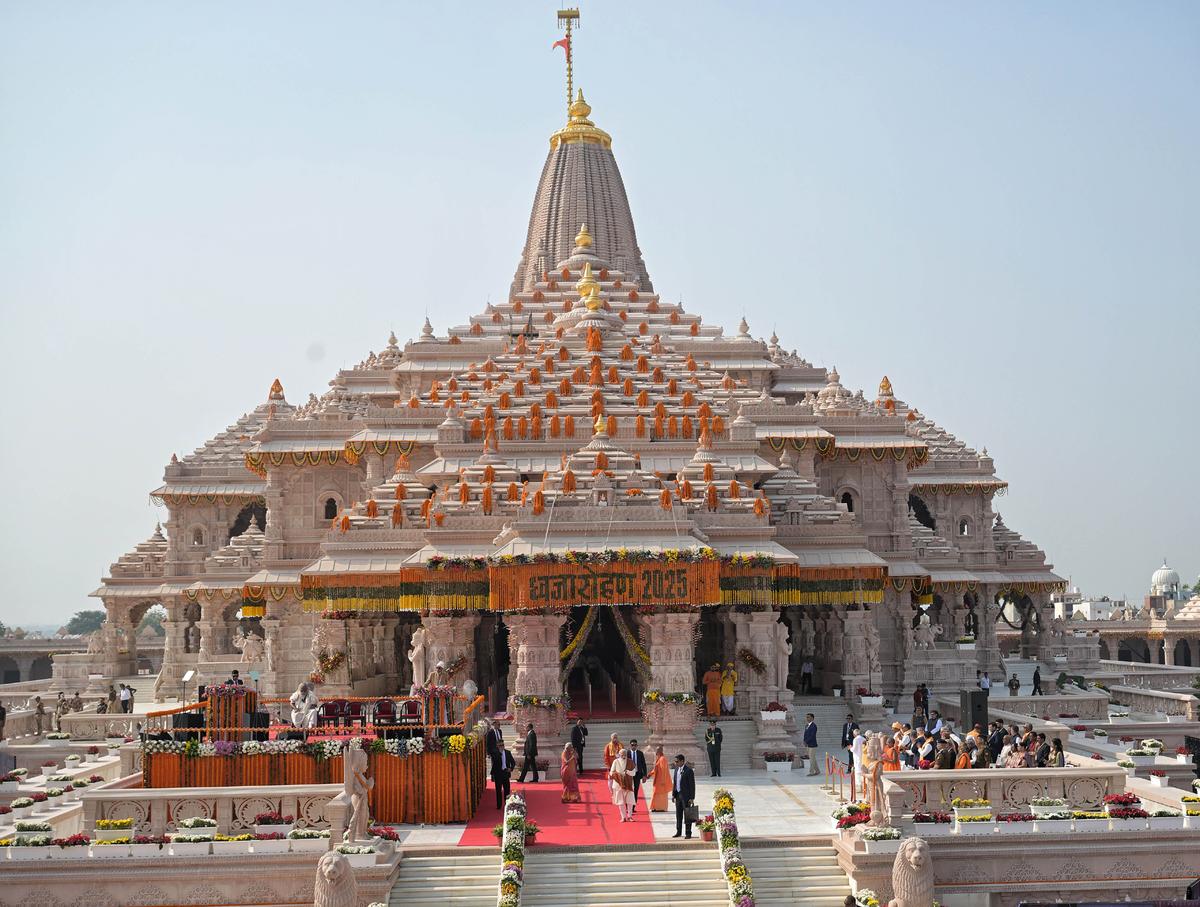
The temple is designed in the traditional Nagara style of north-Indian temple architecture by the Sompura family of Ahmedabad — the same architects whose lineage worked on the rebuilt Somnath under Sardar Patel and on Akshardham in Delhi. The mandir rises on a high adhisthana (plinth) and is built in pink Bansi Paharpur sandstone from Bharatpur, Rajasthan. The garbha-griha holds Ram Lalla; the upper floors will house shrines of Sri Ram in his royal form, Sita-Ram darbar, and other deities. The complex spans about 70 acres and will eventually include parikrama-marg, secondary shrines to Hanuman, the Saptarishis, Mata Sita, Lakshman, Bharat, Shatrughna, and Maharishi Valmiki, a museum, and pilgrim facilities.
The Bal Roop murti
The principal deity is Ram Lalla in his five-year-old child form, dark-stone in colour and just over four feet tall. The murti was selected from three sculpted proposals; the one by Arun Yogiraj of Mysuru was chosen for its grace, the gentle smile, and the form befitting Maryada Purushottam in his child manifestation. The deity is dressed daily in dhoti-pitambar with elaborate ornamental layering; on 22 January each year (the anniversary day), the original consecration vesture is offered.
Ram Janmabhoomi holds a place in the Vaishnava tradition that no other site holds. Shri Ram is held to be the seventh avatar of Vishnu, and the city of Ayodhya — Saket, the eternal city — is the birthplace of the avatar and the seat of his earthly rajya. The Ramcharitmanas of Goswami Tulsidas, the Adhyatma Ramayana, and the bhajans of the Bhakti saints all turn to this very site as the foundational location of Ram-katha.
For the millions of pilgrims who have visited since 22 January 2024, the mandir is held not merely as a temple but as the bhumi-pratyaksha — the site rendered visible — of a devotion that lived in the heart of Sanatan Dharma for centuries. Tradition holds that darshan at Ram Janmabhoomi is among the most spiritually charged acts available to a Hindu pilgrim today; pilgrim numbers have grown to lakhs per day during festival weeks.
History
The Ram Janmabhoomi site has been at the centre of a long, well-documented history. Archaeological evidence, the testimony of the Ramayana, the writings of Tulsidas and earlier Vaishnava saints, and the historical record from the medieval period all establish the site as a continuously revered Ram-shrine. After many decades of legal proceedings — including the Allahabad High Court ruling in 2010 and the final ruling — the Supreme Court of India on 9 November 2019 delivered its unanimous judgement awarding the disputed site for the construction of a Ram temple, with separate land allocated for a mosque elsewhere in Ayodhya.
The Shri Ram Janmabhoomi Teerth Kshetra Trust was established in February 2020 to oversee construction. The Bhumi Pujan took place on 5 August 2020, conducted by the Prime Minister of India. The construction proceeded in phases through 2020-2023. The Pran Pratishtha of Ram Lalla on 22 January 2024 marked the consecration of the principal deity; the wider temple complex continues to be developed with secondary shrines and parikrama-marg planned for completion over the years ahead.
Architecture
The mandir is built in the Nagara style with three storeys, each approximately 20 feet tall. The garbha-griha sits on the ground floor; the central shikhara rises about 49 metres (161 feet) above the plinth; flanking shikharas crown subsidiary mandapas. The temple has five mandapas — Nritya Mandap, Rang Mandap, Sabha Mandap, Prarthana Mandap, and Kirtan Mandap.
The structure uses no steel or concrete in the principal load-bearing elements — only carved pink Bansi Paharpur sandstone, hand-finished by traditional Sompura craftsmen using interlocking stone techniques. The stone is held to last 1000+ years. The plinth is faced with Makrana white marble for the high adhisthana. Brass and gold are used for the central kalashas and the principal mandap-dwaras.
The carved exterior depicts scenes from the Ramayana, the Saptarishis, the Avataras of Vishnu, and the Devi panels. Each pillar carries dozens of carved figurines; the work is the largest single sandstone-temple-carving project in India in over a thousand years.
Rituals & Practices
The temple is open from before sunrise through evening, with a midday closure of about 90 minutes during the Bhog Rajbhog. Five daily aratis are conducted: Mangala Arati (around 4:30 AM), Sringar Arati (around 6:30 AM), Madhyahna Bhog Arati (around 12:00 noon), Sandhya Arati (around 7:30 PM), and Shayan Arati (around 10:00 PM). Slot-based Suprabhata Seva, Sringar Seva, and Bhog Seva are bookable through the Trust portal in advance; the standard Darshan is by free queue with security checks.
The traditional sequence in Ayodhya is to visit Hanuman Garhi first (as the dwarpal), then Ram Janmabhoomi, then Kanak Bhawan, then the smaller shrines. Pilgrims may also walk the inner Ayodhya parikrama which begins and ends at the Janmabhoomi area on auspicious days.
Festivals & Celebrations
| Festival | When | Crowd |
|---|---|---|
| Ram Navami | — | very_high |
| Pran Pratishtha Anniversary | — | very_high |
| Deep Utsav | — | very_high |
| Vijayadashami | — | high |
Ram Navami: The most spiritually charged day at Ram Janmabhoomi.
Pran Pratishtha Anniversary: Honours the Pran Pratishtha â the soul-installation of Ram Lalla.
Deep Utsav: Honours Shri Ram''s return to Ayodhya from vanvas. The original Diwali.
Vijayadashami: Honours the triumph of dharma over adharma.
Prepare for Your Visit
Practical guidance to help you plan your pilgrimage
| Pilgrim Guidance | How to reachThe mandir sits in central Ayodhya, accessed through the Ram Path. Maharishi Valmiki International Airport, Ayodhya Dham (AYJ) is 6 km away. Ayodhya Dham Junction railway station is 3 km. Lucknow (135 km, 3 hours by road) is the nearest major airport. The Ram Path was widened and beautified in 2023-2024 to accommodate large pilgrim flows. PreparationOnline darshan booking via the Shri Ram Janmabhoomi Teerth Kshetra Trust portal is strongly recommended, especially on weekends and festivals. Carry a printed copy with photo ID. Mobile phones, cameras, leather wallets, smart watches, and large bags are not permitted inside the complex — cloakroom available at the entrance. Wear modest, clean clothes; the security checks are thorough. Plan to spend 2-3 hours including queue and darshan. Wheelchair access is available; mention at booking. Best time to visitOctober to March for pleasant weather. Ram Navami in Chaitra (March-April) is the spiritually charged peak — the Surya-tilak (the ray of sunlight that touches Ram Lalla's forehead on the noon of Ram Navami, engineered by ISRO scientists into the temple's design) is the most-attended single moment. 22 January (Pran Pratishtha anniversary) and Deep Utsav (Choti Diwali in Kartik) are also major. For lighter crowds, visit in November after Diwali or late January after 22 January week. |
Location
Ayodhya, UP
Pilgrim photos
No pilgrim photos yet.
Community corrections
No corrections yet.
Edit history
No revisions yet.
Plan Your Visit to Ram Janmabhoomi
Get a custom itinerary and pricing for your trip.
Recommended
Packages for this destination
Pilgrim Notes
On-ground observations from fellow pilgrims
No pilgrim notes yet. Be the first to share on-ground observations!
Sign in to share a note.
Pilgrim Reviews
Be the first to share your experience at Ram Janmabhoomi.
Sign in to write a review.
Nearby sacred places
Discover other sacred places near Ram Janmabhoomi
Explore temples, tirthas, and pilgrimage sites in UP
Explore nearbyPart of these circuits
Walk the traditional pilgrimage routes this destination belongs to.