Shyam Kund sits a hundred metres south of Radha Kund — the same Padma Purana katha gives birth to both. After Krishna slew the asura Arishtasura in bull-form, Radha pointed out that he had done go-hatya and would need to bathe in every tirtha of the world. Krishna struck the ground with his heel, and immediately every great tirtha-water — Ganga, Yamuna, Saraswati, Narmada, Godavari, Kaveri, all the seven sacred rivers and beyond — appeared together in a single pond. That pond is Shyam Kund, and tradition holds that to bathe here is to bathe in every tirtha of Bharat at once.
The kund is the same size and form as Radha Kund — about 110 metres on each side, with stone-paved steps descending on all four sides. The water at Shyam Kund is held by tradition to be slightly darker — hence the name "Shyam" — and is considered Krishna's heart-place. The two kunds together are the supreme tirtha of the Gaudiya tradition.
The connection of the kunds
Radha Kund and Shyam Kund are inseparable in Gaudiya thought. Tradition holds them to be Radha-Krishna in liquid form — Radha as the loving water that purifies, Krishna as the seat of all holiness. The waters of the two kunds were once connected through a small channel; even today, in some seasons, the level of one rises and the other falls in mysterious correspondence. Pilgrims always do darshan at both kunds in a single visit; doing only one is held to be incomplete.
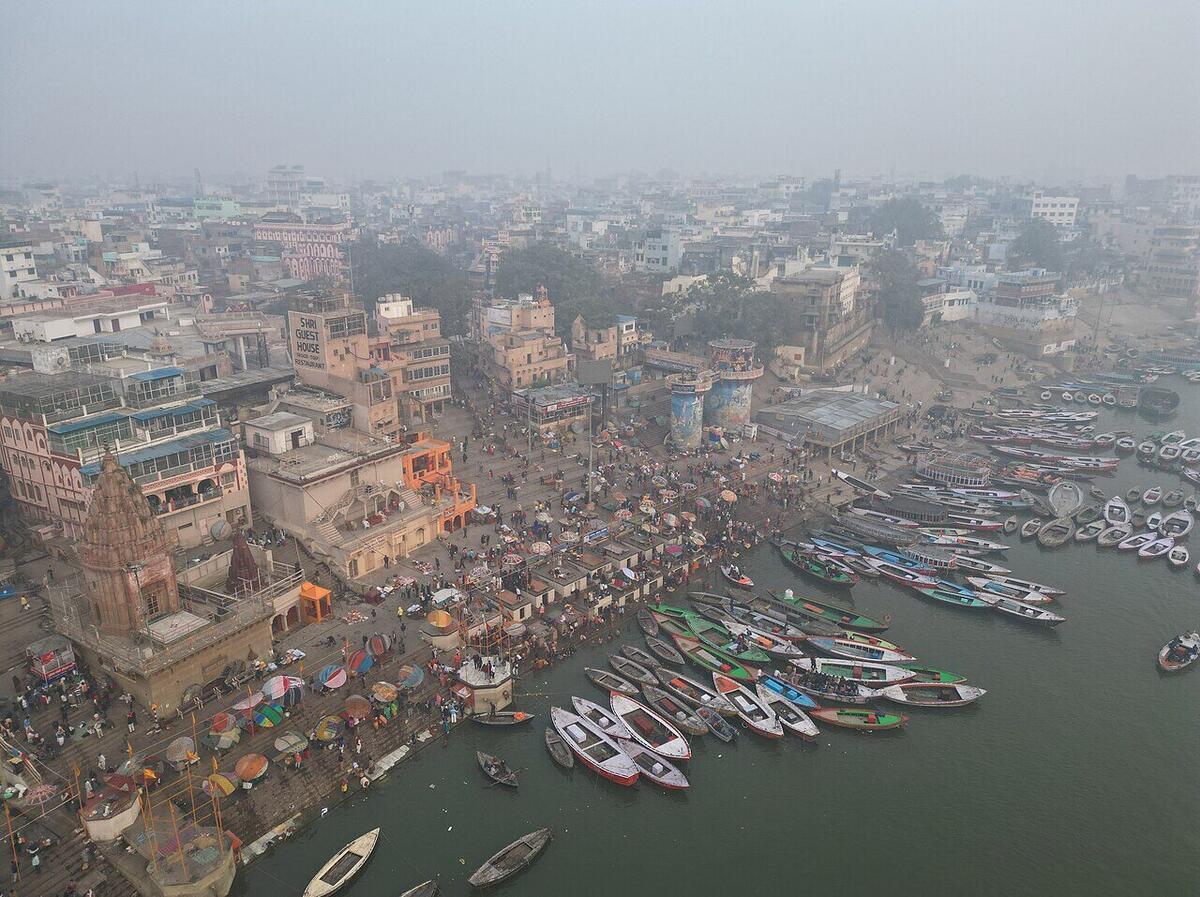
Shyam Kund is held by the Gaudiya Vaishnava tradition to be the supreme seat of sarva-tirtha-jala — the water of every tirtha. A bath in Shyam Kund is held to grant the merit of every pilgrimage of Bharat combined. The Six Goswamis of Vrindavan, Sri Chaitanya Mahaprabhu's followers, and the entire later Gaudiya tradition have praised the kund in their bhajans and theological writings.
While Radha Kund is the seat of prema (love), Shyam Kund is the seat of dharma — the water through which the very impurity of go-hatya could be removed. Together, the two kunds represent the union of love and righteousness that defines Radha-Krishna lila itself.
History
Like Radha Kund, Shyam Kund was rediscovered and established as a modern pilgrim site by the Six Goswamis of Vrindavan in the sixteenth century. Sri Chaitanya Mahaprabhu pointed out the location to Rupa and Sanatan Goswami; Raghunath Das Goswami spent decades restoring and serving both kunds. The stone-paved structure was funded by the same Rajputana patrons who supported Radha Kund.
The bhajan kutirs of several of the Six Goswamis stand by the bank of Shyam Kund as well — particularly Rupa Goswami's and Sanatan Goswami's. The samadhi-shrine of Sri Krishnadas Kaviraja Goswami — author of the Chaitanya-Charitamrita — is at Shyam Kund.
Architecture
Shyam Kund is a square stone-paved tank identical in form to Radha Kund. The water flows in through underground springs and is paired with Radha Kund through both surface and subterranean connections. The walkway around holds the bhajan kutirs of Rupa, Sanatan, and Krishnadas Kaviraja Goswamis, the samadhi-shrines of these saints, and small Vaishnava temples (most notably the Madan-Mohan and Vinod-Lal shrines).
The two kunds together — Radha Kund and Shyam Kund — span a roughly oblong sacred geography about 250 metres long; the walkway between them is paved and lined with small shops, sadhu-shelters, and resting benches.
Rituals & Practices
Worship at Shyam Kund follows the same rhythm as Radha Kund — pilgrim visits through the day for darshan, parikrama of the kund (clockwise), and either a sprinkle-bath or, on Bahulashtami specifically, a full bath. Pilgrims always do both kunds in a single visit. Tradition recommends starting at Shyam Kund (the seat of dharma) before moving to Radha Kund (the seat of prema) — to receive Krishna's grace first and then Radha's.
Worship at the Rupa Goswami and Sanatan Goswami samadhi-kutirs is also customary; these are open through the day, with brief midday closure.
Festivals & Celebrations
| Festival | When | Crowd |
|---|---|---|
| Bahulashtami | — | very_high |
| Govardhan Puja | — | very_high |
| Janmashtami | — | high |
| Krishnadas Kaviraja Samadhi | — | high |
Bahulashtami: Supreme day of the Gaudiya year.
Govardhan Puja: Honours Krishna lifting Govardhan.
Janmashtami: Krishna''s appearance day.
Krishnadas Kaviraja Samadhi: Honours the great Gaudiya theologian-poet.
Prepare for Your Visit
Practical guidance to help you plan your pilgrimage
| Pilgrim Guidance | How to reachShyam Kund is 100 metres south of Radha Kund — combined visit is the standard practice. From Vrindavan or Mathura, taxis run to Govardhan; from Govardhan town, autos run to the Radha Kund-Shyam Kund area. Pilgrims doing the Govardhan parikrama pass through. PreparationSame as Radha Kund — modest dress, towel and change of clothes if planning sprinkle-bath, no soap or shampoo. Photography permitted in the outer area. Best time to visitOctober to March; Bahulashtami in Kartik is the spiritual peak; Govardhan Puja brings the largest parikrama crowds; Janmashtami and Radhashtami are also major. |
Location
Mathura, UP
Pilgrim photos
No pilgrim photos yet.
Community corrections
No corrections yet.
Edit history
No revisions yet.
Plan Your Visit to Shyam Kund
Get a custom itinerary and pricing for your trip.
Recommended
Packages for this destination
Pilgrim Notes
On-ground observations from fellow pilgrims
No pilgrim notes yet. Be the first to share on-ground observations!
Sign in to share a note.
Pilgrim Reviews
Be the first to share your experience at Shyam Kund.
Sign in to write a review.
Nearby sacred places
Discover other sacred places near Shyam Kund
Explore temples, tirthas, and pilgrimage sites in UP
Explore nearbyPart of these circuits
Walk the traditional pilgrimage routes this destination belongs to.