Vrindavan is not a city one visits — it is a city one enters. In the devotional understanding of Vaishnava tradition, Vrindavan is the eternal grove of Shri Krishna and Radharani, the place where the maha-ras unfolded, where the gopis sang, and where Krishna's flute is still heard by those who listen. Pilgrims come not for monuments alone but to be inside the rasa of Braj, to walk the parikrama, to take darshan of Banke Bihari, and to feel the city's soft pull on the heart.
The town centres on a cluster of beloved temples — Banke Bihari in the old quarter where Krishna stands in his tribhanga pose and the curtains open in brief darshan, Radha Raman where the self-manifest deity worshipped by Gopal Bhatt Goswami is served by the same family for almost five centuries, Govind Dev built by Raja Man Singh of Amber in 1590, Radha Vallabh, Madan Mohan, Gopinath, Shyamsundar — together known as the saptadevalaya, the seven thakurs of Vrindavan. The newer ISKCON Krishna Balaram Mandir and Prem Mandir draw their own throngs of devotees.
Katha and local belief
Vrindavan is said to have been rediscovered by the Gaudiya saints — Chaitanya Mahaprabhu, Sanatan Goswami, Rupa Goswami, Jiva Goswami, Raghunath Bhatt, Raghunath Das, and Gopal Bhatt — in the sixteenth century. Tradition holds that Chaitanya pointed out the lila-sthals himself, and his disciples (the Shad-Goswamis) established the temples and the bhajan tradition that the city still lives by. Tradition also remembers that Krishna himself never leaves Vrindavan — he goes to Mathura, Dwarka, Kurukshetra, but always returns in his bhav to Nidhivan at night, where the ras-lila continues for eternity.
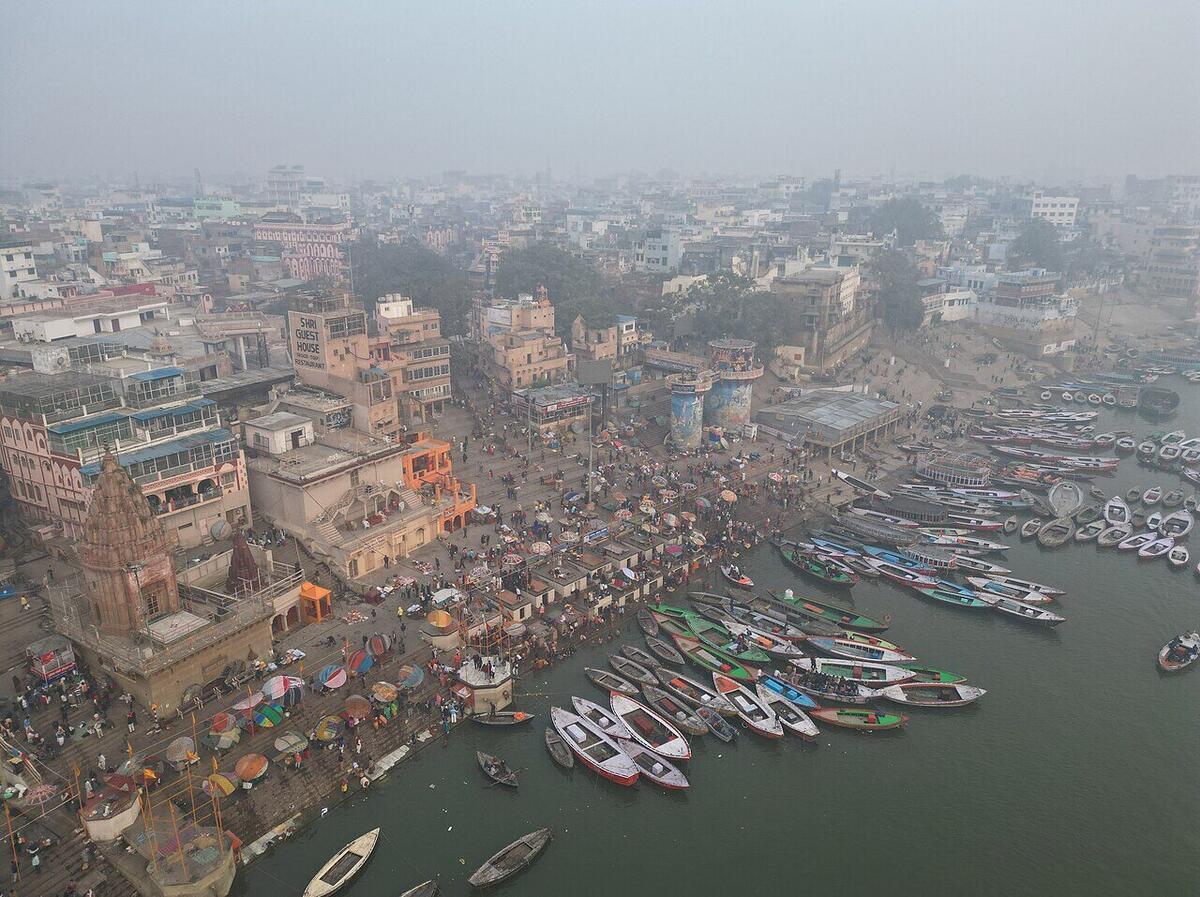
Vrindavan is among the most beloved tirthas of Vaishnava tradition. The Bhagavata Purana, the Gopal Champu, the Gita Govinda of Jayadeva, the songs of Surdas and Mirabai, and the writings of the Shad-Goswamis all turn toward Vrindavan as the eternal seat of Radha-Krishna lila. The town is the spiritual capital of the Gaudiya Vaishnavas (Chaitanya tradition), the Pushti Marga (Vallabh tradition), the Radha Vallabh Sampradaya, and the Nimbarka and Madhva traditions.
The Yamuna at Vrindavan is held to be Krishna's beloved Kalindi. The forest of Vrindavan — the twelve vanas of Braj-mandal — is praised as the eternal grove where Krishna plays the flute. Pilgrims walk the Vrindavan parikrama, the ten-kilometre inner circuit through the bhajan ashrams, the seven thakur temples, and the Yamuna ghats. Tradition holds that walking the parikrama on Ekadashi or in Kartik confers immense devotional merit.
Banke Bihari and the saptadevalaya
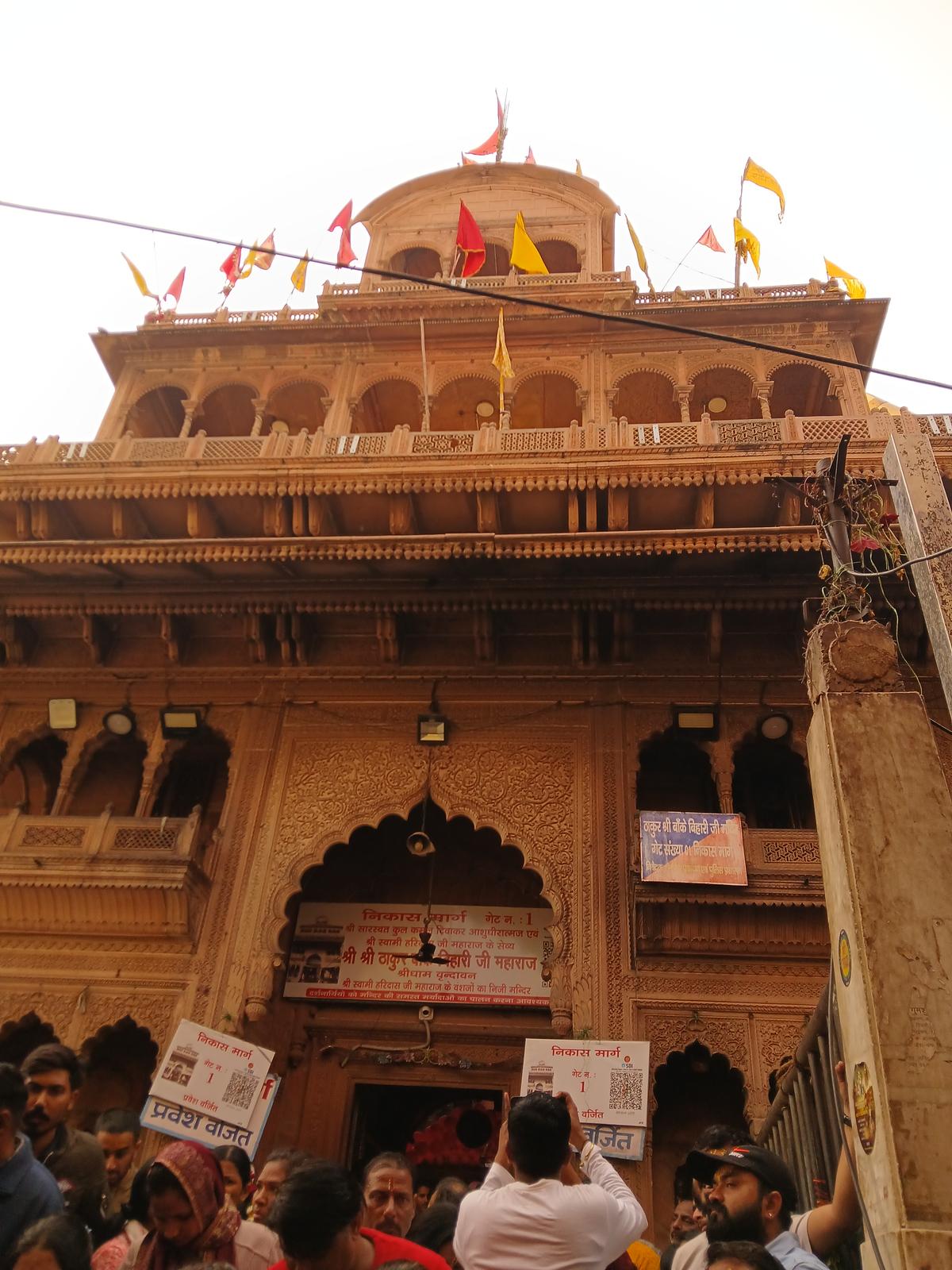
Banke Bihari is for many the heart of Vrindavan. The murti — manifest to Swami Haridas around 1535 from his bhajan at Nidhivan — stands in the tribhanga pose, slightly bent at three places, and is so charged with bhav that the curtain is drawn and reopened every minute or two during darshan, for the devotees and the deity cannot bear too long an exchange of gaze.
History
Vrindavan's sacred memory reaches into the Bhagavata Purana and the long oral tradition of Krishna katha. Historically, the town as the present pilgrim centre grew from the sixteenth century onwards under the Gaudiya rediscovery. Akbar visited Vrindavan and his governors patronised the building of the great Govind Dev temple by Raja Man Singh in 1590, of Madan Mohan, Gopinath, and Jugal Kishore. Many of these temples lost their original deities during the Aurangzeb persecution of 1670 — the deities were carried to Jaipur and Karauli where they continue to be worshipped, and replicas remained at Vrindavan. The original Govind Dev shikhara was truncated; the surviving lower storey remains one of the great Mughal-period temple structures of north India.
Banke Bihari Mandir was built in 1864 by descendants of Swami Haridas. Radha Raman was established by Gopal Bhatt Goswami in 1542 and has been continuously worshipped by his lineage. ISKCON Krishna Balaram Mandir was built by Srila Prabhupada in 1975. Prem Mandir was completed in 2012 by Jagadguru Kripaluji Maharaj. Every century has added to the city, and every layer still receives pilgrims.
Architecture
Vrindavan's architecture spans the Mughal-period temple form (Govind Dev, Madan Mohan), the haveli-mandir of the Pushti Marga, the smaller Gaudiya goswami temples (Radha Raman, Radha Damodar), the courtyard mandirs of the eighteenth century (Banke Bihari, Radha Vallabh), and the modern grand temples (ISKCON, Prem Mandir, Vaishno Devi Mandir).
The seven saptadevalaya temples are intimate spaces with small sanctums, courtyards, and side aratis. Govind Dev was once a seven-storied structure of red sandstone in a hybrid Hindu-Islamic style; its surviving lower hall is enormous, with carved pillars and a vaulted ceiling unusual in temple architecture.
Rituals & Practices
Each temple of Vrindavan has its own daily aarti rhythm. Banke Bihari has five aratis through the day and is famed for the unique 'jhanki' darshan with the curtain. Radha Raman opens shortly after sunrise; the bhog is cooked daily on a fire said to have been kept alight for almost five centuries. ISKCON Krishna Balaram Mandir runs the standard Gaudiya schedule with Mangala Arati at 4:30 AM. Verify exact timings with each temple on the day of darshan.
The traditional sequence on a Vrindavan yatra is the saptadevalaya parikrama — Banke Bihari first (most pilgrims), then Radha Raman, Govind Dev, Radha Vallabh, Madan Mohan, Gopinath, Shyamsundar. Many families add ISKCON Krishna Balaram, Prem Mandir, and Vrindavan Chandrodaya (Nidhivan, where tradition holds the nightly ras-lila still occurs).
Festivals & Celebrations
| Festival | When | Crowd |
|---|---|---|
| Janmashtami | — | very_high |
| Holi | — | very_high |
| Radhashtami | — | high |
| Govardhan Puja | — | very_high |
| Kartik (full month) | — | high |
Janmashtami: The birth of Shri Krishna in Mathura; celebrations in Vrindavan run for days.
Holi: Among the most beloved Holi traditions in India; celebrates Radha-Krishna leela.
Radhashtami: The day of Radharani â beloved of every Vaishnava.
Govardhan Puja: Honours Krishna as Giridhari, lifter of Govardhan.
Kartik (full month): The month dear to Damodar Krishna.
Prepare for Your Visit
Practical guidance to help you plan your pilgrimage
| Pilgrim Guidance | How to reach VrindavanVrindavan is well-connected. The nearest major airport is Indira Gandhi International Airport, Delhi (about 150 km, 3 hours by Yamuna Expressway). The nearest railhead is Mathura Junction (12 km away, 30 minutes by road); Mathura is on the main Delhi-Mumbai trunk and has direct trains from across India. From Mathura, taxis, autos, and shared vans run frequently to Vrindavan. Preparation for pilgrimsThe old city of Vrindavan is congested and best explored on foot or by e-rickshaw. Carry comfortable walking shoes — the saptadevalaya parikrama is about 10 km. The Yamuna Expressway connection makes day-trips from Delhi feasible, but two days in Vrindavan is recommended to do justice to the city. Hotels and dharamshalas are abundant; ISKCON guest houses, the Mathura Vrindavan Development Authority hotels, and many private guest houses are available. Booking in advance is strongly recommended during Janmashtami (August/September), Holi (March), and Kartik (October-November). Best time to visitOctober to March is the most pleasant weather. Janmashtami in Bhadrapada (August-September) is the spiritual peak — the city is intensely crowded but the bhav is unmatched. Holi in Phalguna (March) is celebrated for over a week here — the famous Lathmar Holi of Barsana and Nandgaon, the widows' Holi at the Gopinath temple, and the play of colours at Banke Bihari are among the most beloved Holi traditions in India. Avoid May-June (hot) and the deep monsoon if mobility is a concern. |
Location
Mathura, UP
Pilgrim photos
No pilgrim photos yet.
Community corrections
No corrections yet.
Edit history
No revisions yet.
Plan Your Visit to Vrindavan
Get a custom itinerary and pricing for your trip.
Recommended
Packages for this destination
Pilgrim Notes
On-ground observations from fellow pilgrims
No pilgrim notes yet. Be the first to share on-ground observations!
Sign in to share a note.
Pilgrim Reviews
Be the first to share your experience at Vrindavan.
Sign in to write a review.
Nearby sacred places
Discover other sacred places near Vrindavan
Explore temples, tirthas, and pilgrimage sites in UP
Explore nearbyPart of these circuits
Walk the traditional pilgrimage routes this destination belongs to.