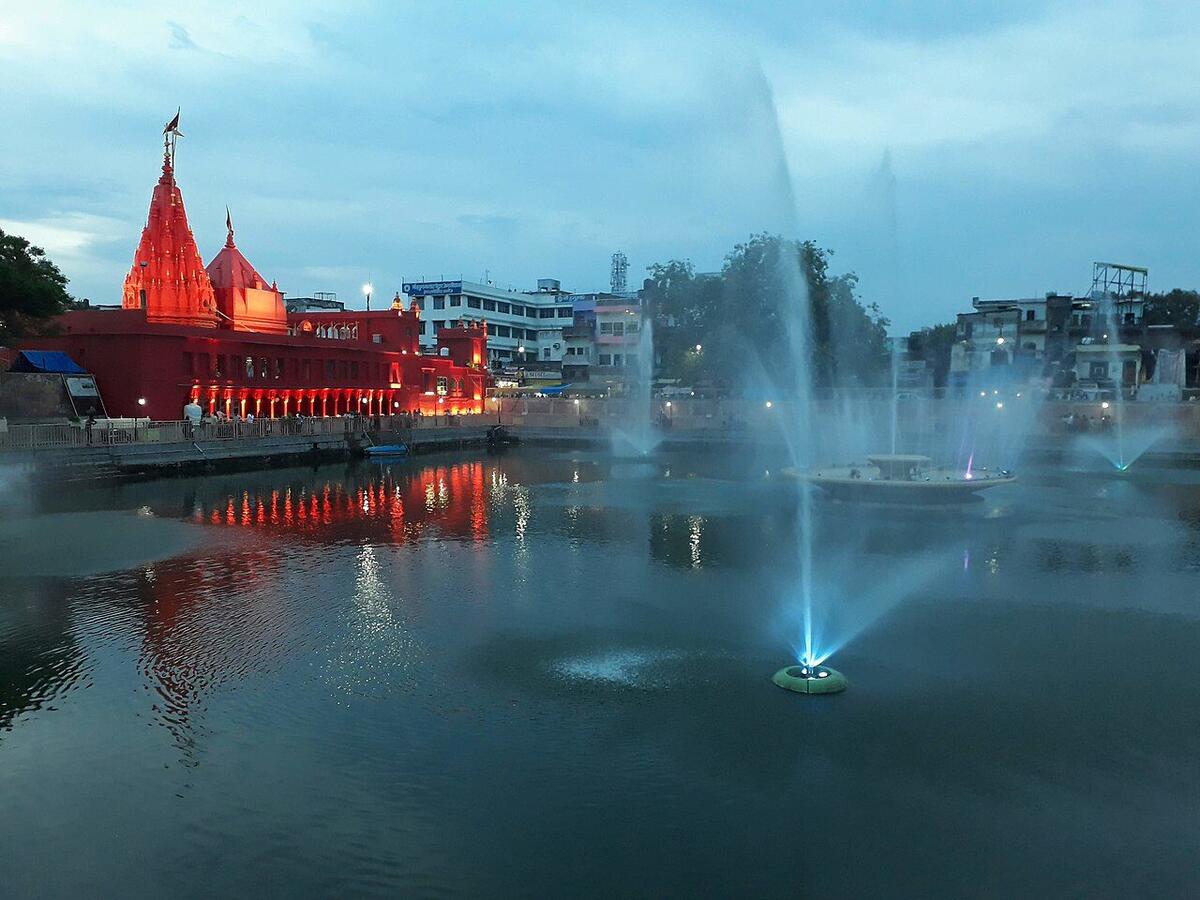
South of the old city, where the lanes finally loosen into proper roads, stands a temple you will identify from a hundred metres away: a many-tiered shikhara the colour of sindoor, red-ochre from base to crown, rising beside a great square tank of stone steps. This is the Durga Mandir of Durga Kund — the principal seat of the Devi in Kashi, the temple of the fierce Mother who, the traditions say, fought for this city and then declined to leave it. Shiva may be Kashi's king and Bhairav its kotwal, but every Banarasi knows who guards the southern gate.
We bring our yatris here on the same gentle southern circuit as Sankat Mochan and Tulsi Manas, and we linger longest at this stop during Navratri, when the temple becomes one of the most intense Shakti darshans in North India. Here is the temple's story — the queen who built it, the murti no sculptor made, the kund that was once fed by the Ganga — and everything practical a pilgrim needs.
A Bengali Queen's Gift to Kashi
The temple as it stands was built in the 18th century — around 1760, by most accounts — by Rani Bhabani of Natore, the great zamindar-queen of Bengal whose piety and public works were famous across the north. Bengal's bond with Kashi runs deep: for centuries Bengali widows, scholars and renunciants came to live out their days by the Ganga here, and Bengali patrons built ghats, dharamshalas and temples across the city. Rani Bhabani's Durga Mandir is the grandest of these gifts — a statement of the Devi's honour in Shiva's own capital, raised in the North Indian Nagara style, its shikhara built as clustered spires rising one from another, the whole washed in the red ochre that is the Mother's own colour. The temple finds mention in the Kashi Khanda's sacred geography of the city, and the site is held to be far older than the present building — queens renew temples in Kashi; they do not invent them.
The Murti No Hands Made
Ask the temple's pujaris about the murti in the sanctum and you will be told, with quiet firmness, that it was never installed at all. Tradition holds the image of the Devi here to be swayambhu — self-manifested — not carved, not consecrated by any human hand, but appeared of its own accord; the elders call such an image nishkalanka, without blemish of human making. In the sanctum the Devi is present as yantra and murti together, and the priests will tell you the shakti here does not depend on either — it is the place itself the Mother chose.
Why she chose it, the texts explain twice over. The Devi Bhagavata Purana tells of Sudarshan, an exiled prince who loved and won Shashikala, daughter of the king of Kashi. When the rejected royal suitors marched on the city in fury, Sudarshan called on the Devi — and she came, riding her lion into battle, and scattered the armies of kings for the sake of one faithful devotee. The grateful king of Kashi begged her to remain and guard the city forever, and this temple marks where she consented. The second tradition reaches further back: after her great war with the demons Shumbha and Nishumbha, the Devi rested here — and it was her cast-down sword, the Kashi Khanda says, that cut the channel of the Assi river which still names the southern edge of the city. Rest and guardianship: the two moods of the Mother, and the temple holds both. Devotees know the presiding Devi as Kushmanda, and in the city's Navratri geography this is her seat.
Durga Kund: The Tank Beside the Temple
The temple shares its name with the kund — the great square bathing tank beside it, stone-stepped on all four sides, one of the last surviving sacred tanks of a city that once held dozens. In earlier centuries the kund was connected to the Ganga by a channel, its waters rising and falling with the river; the channel is long closed and the tank now keeps its own still water, renewed by rain and by pumps rather than by the river's moods. Pilgrims no longer take a full snan here, but the parikrama of the kund — a slow circuit of the water with the red shikhara reflected in it — remains part of the visit, and on festival days the steps fill with devotees floating diyas at dusk. Treat the water with the respect due a tirtha: no washing, no rubbish, no feet dangled in from the steps.
Navratri in Kashi: The Temple at Full Flame
Twice a year, in the Navratris of Chaitra (spring) and Ashwin (autumn), this temple becomes the burning heart of Shakti worship in Varanasi. The queues begin before dawn and hold all day; the lanes around fill with stalls of chunri, coconuts, sindoor and marigold; and the sanctum runs at a pitch of devotion that even Kashi rarely reaches. Banaras keeps an old Navratri tradition of visiting a different form of the Devi on each of the nine days — the Nav Durga and Nav Gauri yatras — and Durga Kund's turn brings the biggest crowds of the cycle. Kumari puja, the worship of young girls as living embodiments of the Devi, is performed here in the season, and on the eighth and ninth days the press of pilgrims is immense.
Our honest advice for Navratri darshan: come the moment the temple opens — around dawn — or accept a wait that can run past two hours; bring no bags, keep offerings simple, and do not attempt it at all with very elderly yatris on the ashtami and navami days, when the crowd is at its peak. On any ordinary day of the year, by contrast, this is one of the calmest major darshans in the city — twenty unhurried minutes, the smell of camphor and marigold, monkeys watching from the parapets. Timings follow the usual Kashi rhythm — open from early morning, a midday close, then evening until after aarti — and they shift on festival days, so confirm locally for your date.
Autumn adds one more layer that delights Bengali pilgrims especially: in the days of Sharad Navratri, Kashi's old Bengali quarters — Bengali Tola and the lanes toward the river — raise their Durga Puja pandals, and the city that received Rani Bhabani's temple two and a half centuries ago fills again with dhak drums and shiuli-scented evenings. A pilgrim at Durga Kund in that season can take the Devi's darshan in her Kashi form by day and walk the pandals by night — two devotional dialects of the same Mother, in one city that speaks both fluently.
Reading the Temple: What to Notice Inside
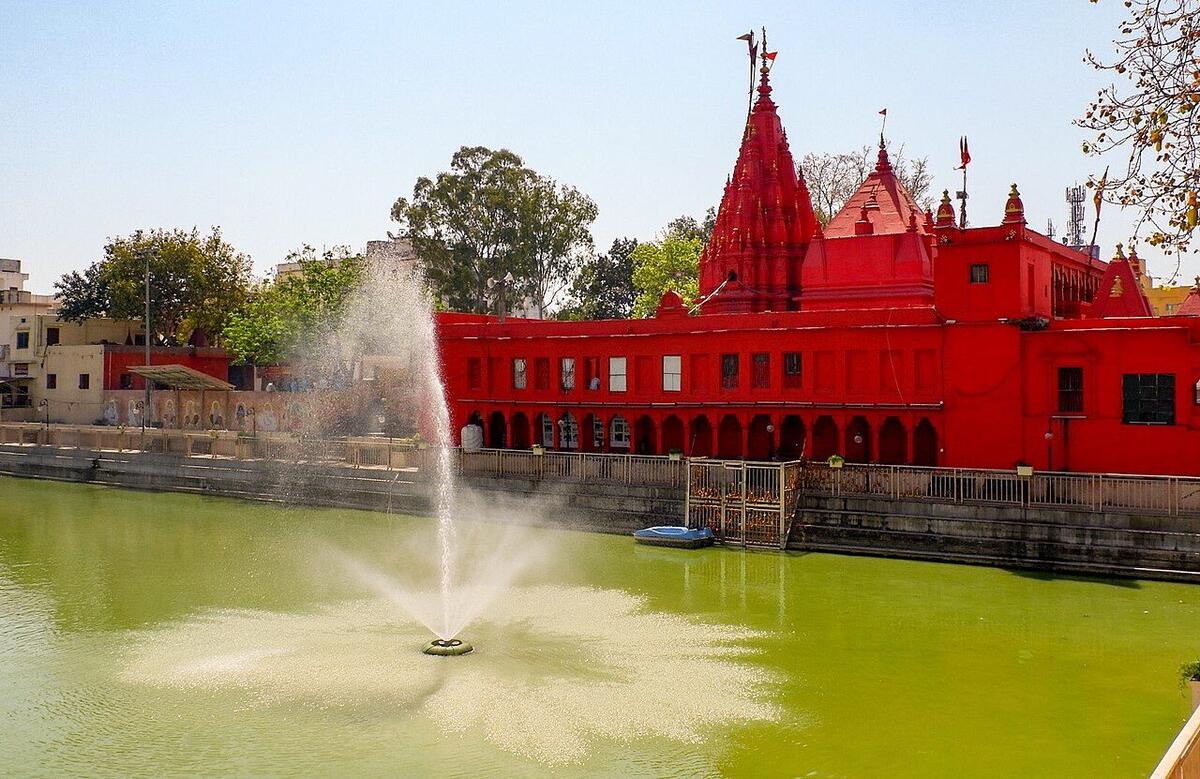
Give the building itself ten unhurried minutes, because Rani Bhabani's architects built meaning into every tier. The shikhara is a cluster of five spires — smaller towers gathered and merging into one summit — which the tradition reads as the five elements, the five faces of devotion, resolving into the single Devi; count them from the far side of the kund, where the whole composition stands mirrored in the water. The forecourt holds a pillared mandapa with carved stone columns, and the compound walls carry small shrines that reward a slow parikrama: Bhairav as guardian, Ganesh ji, Mahishasura-mardini panels, and the Devi's lion waiting in stone. Notice, too, the havan kund in the courtyard, warm with continuous use, and the worn threshold of the sanctum — polished not by masons but by two and a half centuries of foreheads and fingertips. The temple is compact; its detail is not.
Historical honesty asks one more note. Like many great Shakti temples, this one's past includes animal sacrifice on certain observances; today the offerings are overwhelmingly the vegetarian ones of flowers, coconut, chunri and sweets, and the temple's daily life is entirely of that gentler kind. We mention it because pilgrims sometimes arrive with half-heard stories: come without hesitation, and bring the children.
Beyond Navratri: The Devi's Year at Durga Kund
Navratri is the summit, but the temple keeps festival strength across the calendar. In the month of Shravan, the temple and its surroundings host one of Kashi's liveliest melas — the streets toward the kund fill with swings, stalls and families, a joy that has been painted and photographed since the nineteenth century. Every Tuesday and Saturday the sanctum runs at double devotion, and the aarti hours — after dawn and at dusk — are the temple's daily best, when the bells, the drum and the camphor-flame turn the small courtyard briefly enormous. If your Kashi days include a Tuesday, do what Banarasi families do: Durga ji in the evening, Sankat Mochan after, and dinner in the lanes on the walk home.
A Word About the Monkeys
The temple's garrison of monkeys is famous enough that colonial-era visitors simply called this "the Monkey Temple" — a name we discourage, for it mistakes the tenants for the landlady. But the tenants are real and they are professionals: carry prasad in a closed bag until the moment of offering, hold spectacles and phones firmly, and do not feed them by hand however charming the request. They trouble no one who gives them no opening. Banarasis, for their part, regard the troop with a certain civic pride — the Devi's temple keeps Hanuman ji's kin, they say, and a guard of the Mother's house was never going to be timid.
Planning Your Visit
- Where. On Durgakund Road in southern Varanasi — ten minutes by auto from Assi Ghat, five from Sankat Mochan, fifteen to twenty from Godowlia.
- Pair it. The Tulsi Manas Mandir stands practically next door — two minutes on foot — and Sankat Mochan is one short ride away. The three together make the classic southern evening circuit; we walk it with our yatris on the second day of our two-day Kashi itinerary.
- When. Early morning for stillness; late afternoon into the evening aarti for atmosphere, ending with diyas on the kund. Tuesdays and Saturdays, dear to the Devi and to Hanuman ji next door, are busier and brighter.
- Offerings. Chunri, coconut, flowers and sweets are available at the stalls outside; the pujaris will guide first-timers kindly. Sindoor from this temple is carried home as the Mother's blessing.
- Comfort. The courtyard is compact and flat once you are past the entrance steps; elderly pilgrims manage it easily outside festival crowds. Dress modestly, as for any temple — our temple dress guide has the details.
The Devi's Side of Kashi
Pilgrims come to Varanasi for Shiva, and rightly — but Kashi has always been guarded by the Mother as much as ruled by Mahadev, ringed by her forms at every compass point, from Vishalakshi in the lanes near the river to Durga ji here at the southern approach. To take darshan at Durga Kund is to greet the power that fought for this city and stayed on watch; to skip it is to see only half of Kashi's face. Come in the ordinary season for the quiet, or in Navratri for the fire — and if you would like the whole southern circuit arranged, with the timings judged and the queues understood, our Kashi Yatra packages include the Devi's darshan as a matter of course. Jai Mata Di. Har Har Mahadev.
Related articles
Varanasi in Winter: Dev Deepawali, Fog on the Ganga, and the Season of Malaiyo
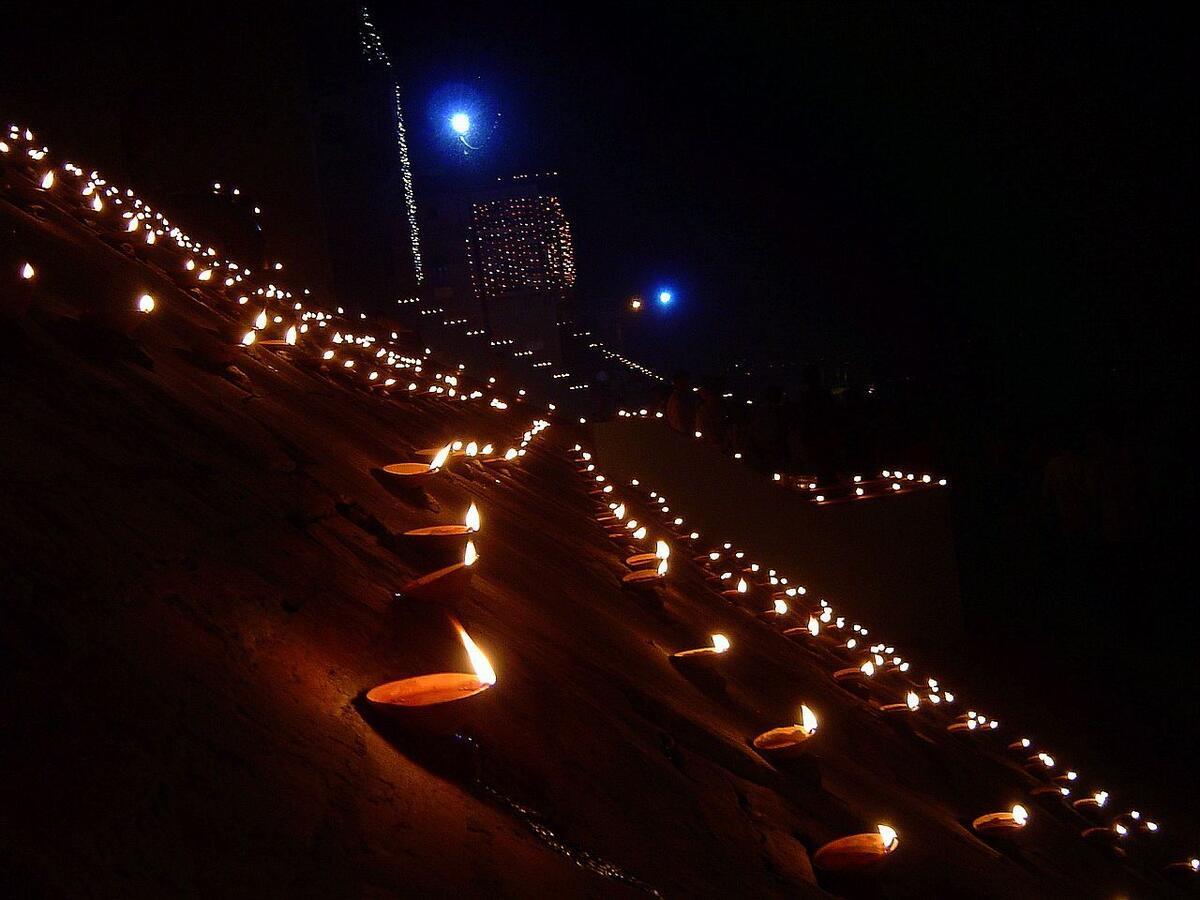
November to February is Kashi at its kindest and most crowded — Dev Deepawali's lakhs of lamps, fog-wrapped dawn boat rides, the dawn-only dessert called malaiyo, what to pack, and why winter yatras must be booked months ahead.
Tulsi Manas Mandir: The Temple Built Where the Ramcharitmanas Was Born
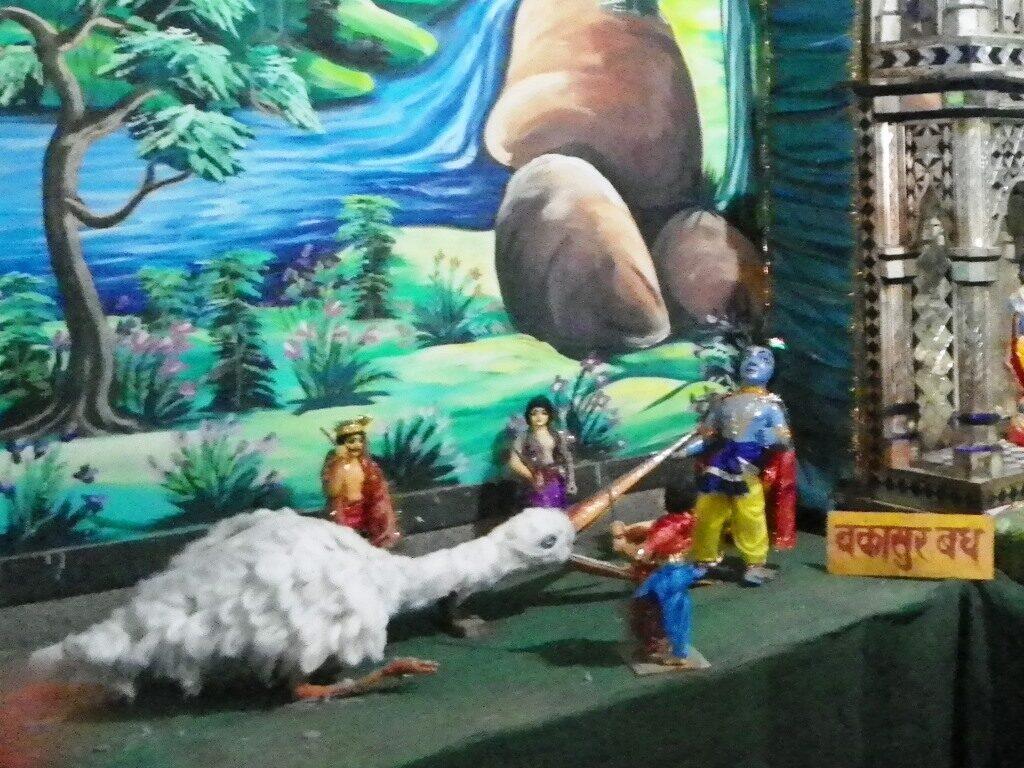
On the ground where Goswami Tulsidas composed the Ramcharitmanas stands a white marble temple whose walls carry his verses end to end. The story of the people's Ramayana, the moving tableaux upstairs, the Durga Mandir pairing, and a perfect evening plan.
The New Vishwanath Temple at BHU: Malaviya's Marble Vision, Open to All
Inside the great marble Shiva temple of Banaras Hindu University — Madan Mohan Malaviya's vision, the Birla family's decades of building, a sanctum open to every caste and creed, scripture-inscribed walls, and how to plan your campus visit.