Most temples enshrine a deity. The Tulsi Manas Mandir enshrines a book — and in doing so honours the deity more completely than marble alone ever could. This serene white temple on the Durgakund road in southern Varanasi stands, tradition holds, on the very ground where Goswami Tulsidas composed the Ramcharitmanas — the retelling of Ram's story that became the scripture of the common people of North India, sung in courtyards and cowsheds, memorised by grandmothers who never learned to read. Bhagwan Ram is the deity here; but the walls, floor to ceiling, carry the poem — and pilgrims come as much to read as to pray.
We rate this among the most quietly moving darshans in Kashi, especially for Hindi-speaking families, and it asks almost nothing of you: no queue to speak of, no lane-maze, a flat and gentle compound. Here is the story of the place, what to see inside, and the evening plan that pairs it perfectly with the Durga Mandir next door.
The Poet Who Gave Ram to the People
To understand the temple, understand what happened on this ground four and a half centuries ago. Tulsidas — saint, scholar, and the greatest devotional poet Hindi has produced — made Kashi his home for much of his life; his akhara and dwelling survive at Tulsi Ghat by the river, and he established the Sankat Mochan Hanuman Mandir that still anchors the city's devotion to Hanuman ji. In his day the Ram katha lived in Sanskrit, the language of the learned. Tulsidas chose instead to compose in Awadhi — the spoken tongue of the ordinary people — beginning the work, tradition records, in Ayodhya in 1574 and completing much of it here in Kashi, in the quarter where this temple now stands. The learned establishment of his time objected fiercely; the people answered by making the Manas the most read, sung and beloved book in North India, a place it has never surrendered. The chaupais your grandmother recites, the Sundarkand sung on Tuesday evenings, the Ram Naam on a million lips — the spring of all of it is, by tradition, here.
A Modern Temple for an Immortal Poem
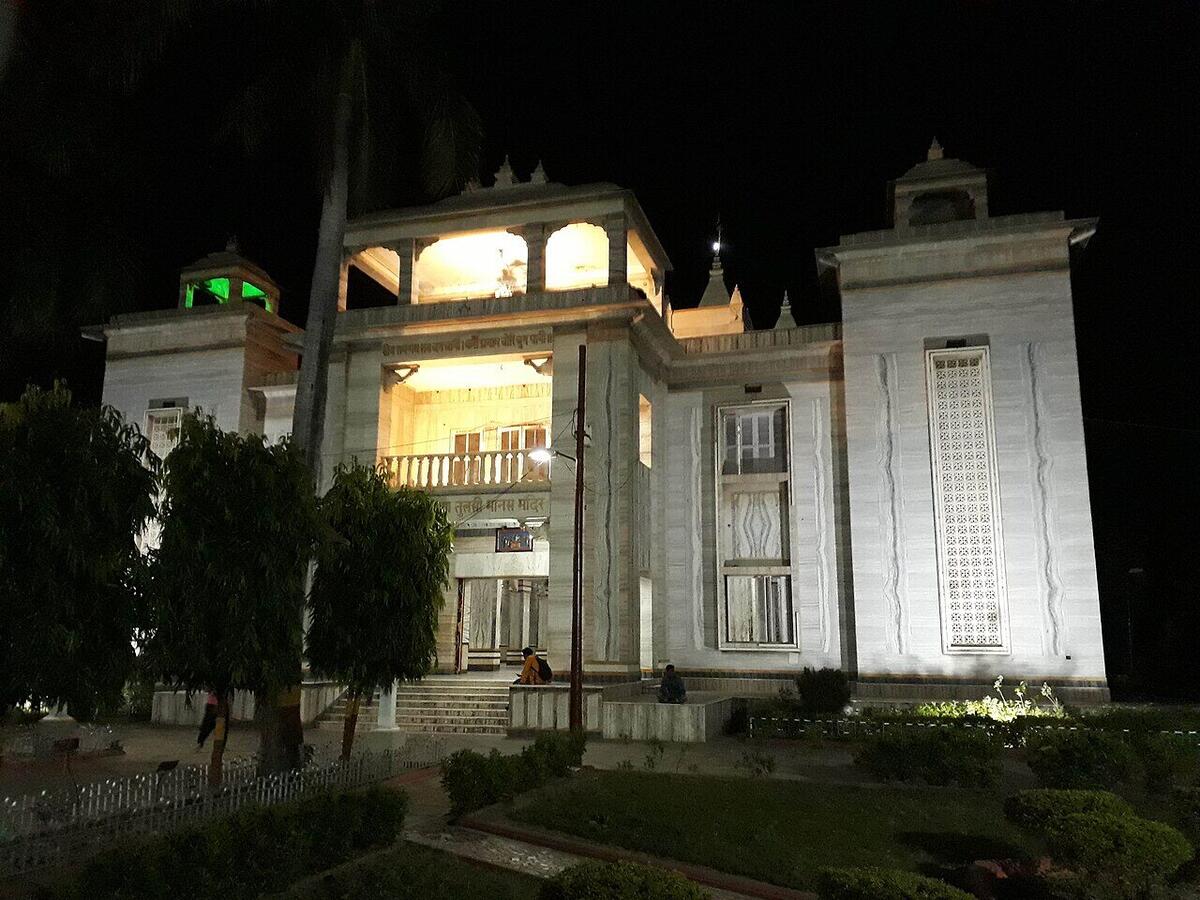
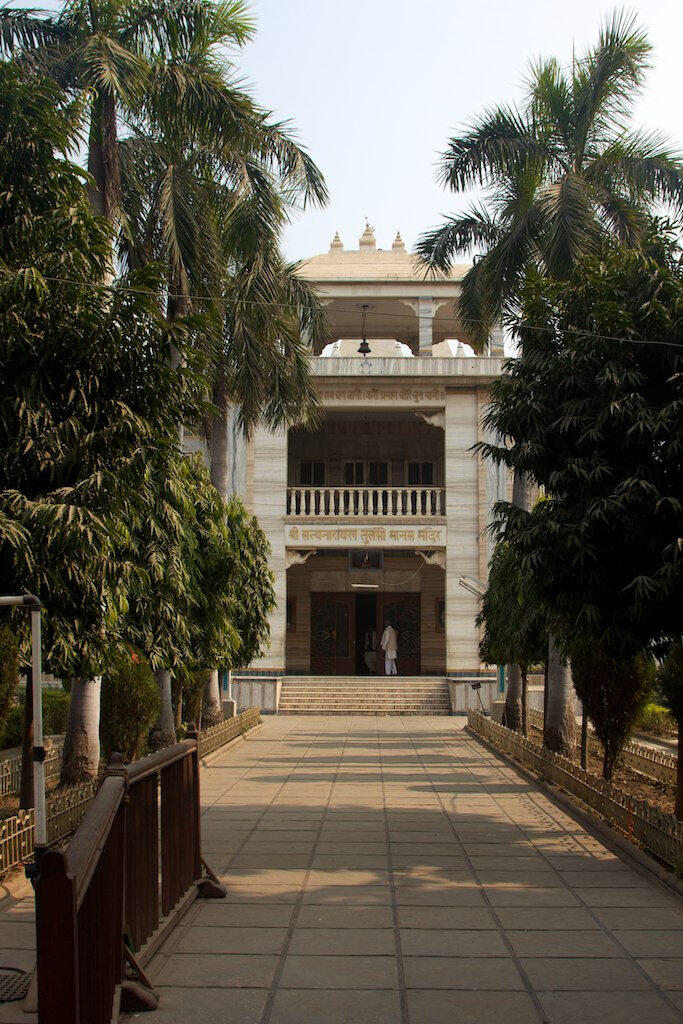
The temple itself is young, and honestly so. It was built in 1964 by the Sureka family, philanthropists of Bengal, and inaugurated by Dr. Sarvepalli Radhakrishnan, then President of India — a philosopher-president opening a temple to a poet: Kashi enjoys such symmetries. The style is bright white marble, generous courtyards, and gardens with fountains that play in the evenings; the sanctum holds Bhagwan Ram with Mata Sita, Lakshman ji and Hanuman ji in attendance. It carries none of the old city's weight of centuries — and it does not pretend to. What it offers instead is the poem, presented with a completeness no other place attempts.
Walls That Recite: Reading the Manas in Marble
The famous feature first: the inner walls of the temple are engraved with the verses of the Ramcharitmanas, running panel after panel through the halls, accompanied by painted and carved scenes from every kand of the epic. Stand anywhere and the wall beside you is speaking — Ram's birth, the breaking of the bow, the exile, the burning of Lanka, the return to Ayodhya. For pilgrims who read Devanagari the effect is extraordinary: you do not tour this temple so much as read it, and no two visits read the same pages. We have watched elderly yatris find the exact chaupai they have sung all their lives and touch the marble below it like the feet of a guru.
Give the walls half an hour at least. Families should walk them slowly with children, telling the story panel by panel — there is no better illustrated Ramayana in the city, and it cannot be bought, only visited.
Upstairs: The Moving Ramayana
The temple's second floor holds its most charming surprise: galleries of animated tableaux — moving figures enacting scenes from the Ram katha — automata in rich costume that bow, gesture and turn as the episodes play out. It is devotional folk-art of a very particular mid-century kind, maintained with obvious love, and children are transfixed by it; a small fee may apply for the displays, and the floor keeps its own hours within the temple's day, generally opening with the main temple and pausing across the afternoon closure. Approach it with the spirit in which it is offered — not spectacle, but seva: another way of telling the story to people who cannot stop hearing it.
Downstairs again, note the figures of Tulsidas himself in the temple, and the displays around the compound recounting his life — the difficult childhood, the turning to Ram, the composition of the Manas, the founding of Sankat Mochan. The temple is, all at once, a shrine to Ram, a memorial to his poet, and a library with one immortal book.
The Perfect Pairing: Durga Mandir Next Door
The Tulsi Manas Mandir stands practically beside the great red Durga Mandir of Durga Kund — two minutes on foot separate the gates — and the two make one of the most natural darshan pairs in Varanasi: the Devi's ancient seat and the poet's modern memorial, shakti and bhakti, red ochre and white marble. Add Sankat Mochan, five minutes away by auto — the Hanuman temple Tulsidas himself established — and you have the classic southern circuit, all flat, all easy, all outside the old city's crush. We walk this arc with our yatris constantly, and it forms the second afternoon of our two-day Kashi itinerary.
An Evening Plan That Works Every Time
4:00 PM — begin at Sankat Mochan for Hanuman ji's darshan as the temple fills with the evening's Sundarkand recitation; hold your prasad close through the monkey gauntlet. 5:15 PM — a short ride to Durga Kund: darshan of the Devi, a slow parikrama of the kund as the light turns gold. 6:00 PM — walk the two minutes to Tulsi Manas Mandir for the quietest hour of the circuit: the evening aarti in the marble hall, the verse walls in soft light, the garden fountains playing after dark. 7:00 PM — onward ten minutes to Assi Ghat for the evening Ganga aarti on the steps, or simply chai by the river to close the day. Three darshans and a sunset, without one steep step or one dense lane: it is the evening we design for grandparents, and everyone else loves it too.
Tulsidas's Kashi: A Small Pilgrimage Within the Pilgrimage
For devotees of the Manas, the temple is one station of a natural three-stop yatra through the poet's own city. Begin at Tulsi Ghat by the river, where the Goswami lived: his rooms, his wooden sandals and the akhara he patronised are still kept there, and the ghat below is where tradition says Hanuman ji first gave him darshan of the divine. Then Sankat Mochan, the temple he raised to that same Hanuman ji, where the Sundarkand is sung to this day as he taught the city to sing it. End here at the Manas Mandir, on the ground of the writing itself. Three stops, one morning or one unhurried evening, and you will have walked the whole arc of a life that changed how a quarter of humanity prays. We arrange this circuit often for Manas-path families and satsang groups — it pairs beautifully with a recitation session on the lawns.
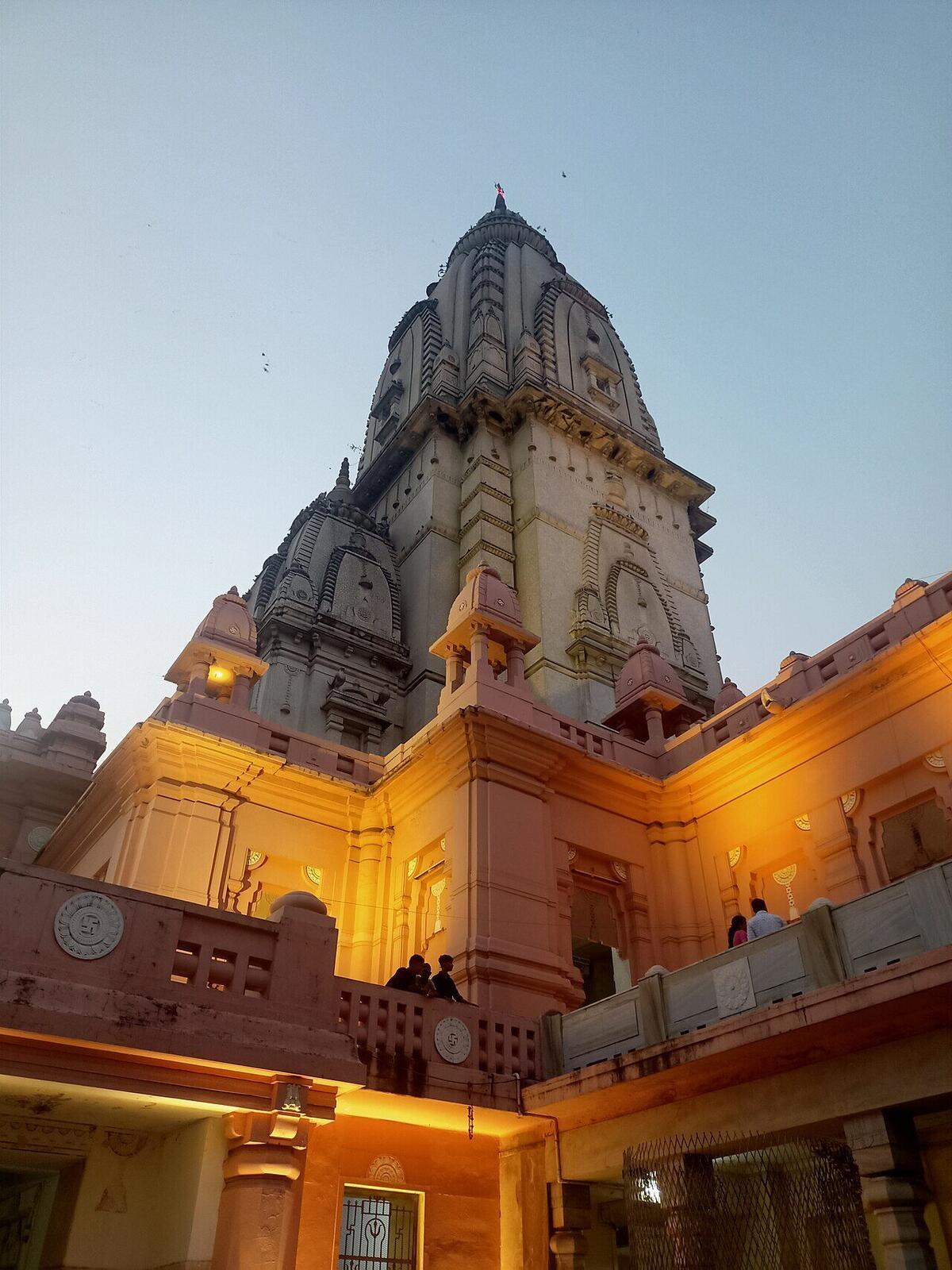
One more connection worth carrying: the poet's masterwork and the city's great university stand in a single tradition. The verses you read here in marble are quoted on the scripture walls of the New Vishwanath Temple at BHU, fifteen minutes away — the sixteenth-century people's poet and the twentieth-century people's temple, finishing each other's sentences across the southern city.
And if your yatra falls in the autumn weeks after Tulsidas Jayanti, know that the Manas does not stay on these walls — it gets up and walks. Across the river at Ramnagar, the Kashi Naresh's Ramlila has staged the entire epic every year for some two centuries: a month of evenings in which the whole town becomes the stage — Ayodhya in one quarter, Lanka in another — and lakhs follow the swarups from scene to scene by lantern light. It is the Manas as Tulsidas intended it: not recited at the people but lived with them. Ask us about timing a visit to catch an evening of it; the pairing of the marble walls by day and the living lila by night is one of the profoundest experiences the Kashi calendar offers.
Questions Pilgrims Ask Us Here
Can I read the walls if my Hindi is weak? The verses are in Awadhi written in clear Devanagari — anyone who reads Hindi will follow, and the carved and painted scenes carry the story for everyone else. Non-Hindi readers still find the visit worthwhile for the sanctum, the tableaux and the gardens; it is simply a deeper darshan for those who can read.
Is it worth it on a one-day visit to Kashi? With a single day, the river and the jyotirlinga come first, and we say so honestly. From the second day onward, this southern circuit is the first thing we add.
Manas Mandir or Durga Mandir first? Durga ji first, then here — the Devi's courtyard is livelier and the Manas halls are the better place to end quietly. On Tuesdays reverse it, and let Sankat Mochan crown the evening instead.
Practical Notes
- Timings. The temple follows Kashi's usual two-session day — open from early morning to about noon, then from mid-afternoon until about 9:00 PM. Timings shift on festival days and in special seasons, so confirm locally for your date.
- Entry. Free; shoes go to the stand at the gate. Photography rules inside change from time to time — ask before you raise a camera, especially near the sanctum.
- When it shines. Evenings, for the aarti and the lit gardens; and above all Ram Navami and the days around it, and the month of Shravan, when special Manas recitations fill the halls. On Tulsidas Jayanti the temple honours its poet with particular devotion. Crowds on these days are larger; timings stretch.
- Comfort. Among the easiest temple visits in Varanasi: level compound, gardens with places to sit, washrooms nearby on the Durgakund road, autos at the gate. Dress modestly as always — our temple dress guide covers it.
- Time needed. Forty-five minutes for darshan and the walls; add thirty for the upstairs tableaux with children.
Why This Darshan Stays With You
Kashi humbles a pilgrim with age and scale — the jyotirlinga's millennia, the crescent of ghats, the fire that never goes out. The Tulsi Manas Mandir works differently. It reminds you that the tradition is not only inherited but made — that one man sat on this ground with a reed pen and the people's language and built something as permanent as any stone in the city. Read one chaupai off the wall aloud, in a whisper, and you have joined an unbroken recitation four and a half centuries long. Then step out; the Devi is next door, Hanuman ji is up the road, and the river that heard the poem first is ten minutes away. If you would like this circuit woven into a full yatra — timings judged, evenings sequenced, elders provided for — our Kashi Yatra packages do exactly that. Jai Shri Ram. Har Har Mahadev.
Related articles
Varanasi in Winter: Dev Deepawali, Fog on the Ganga, and the Season of Malaiyo
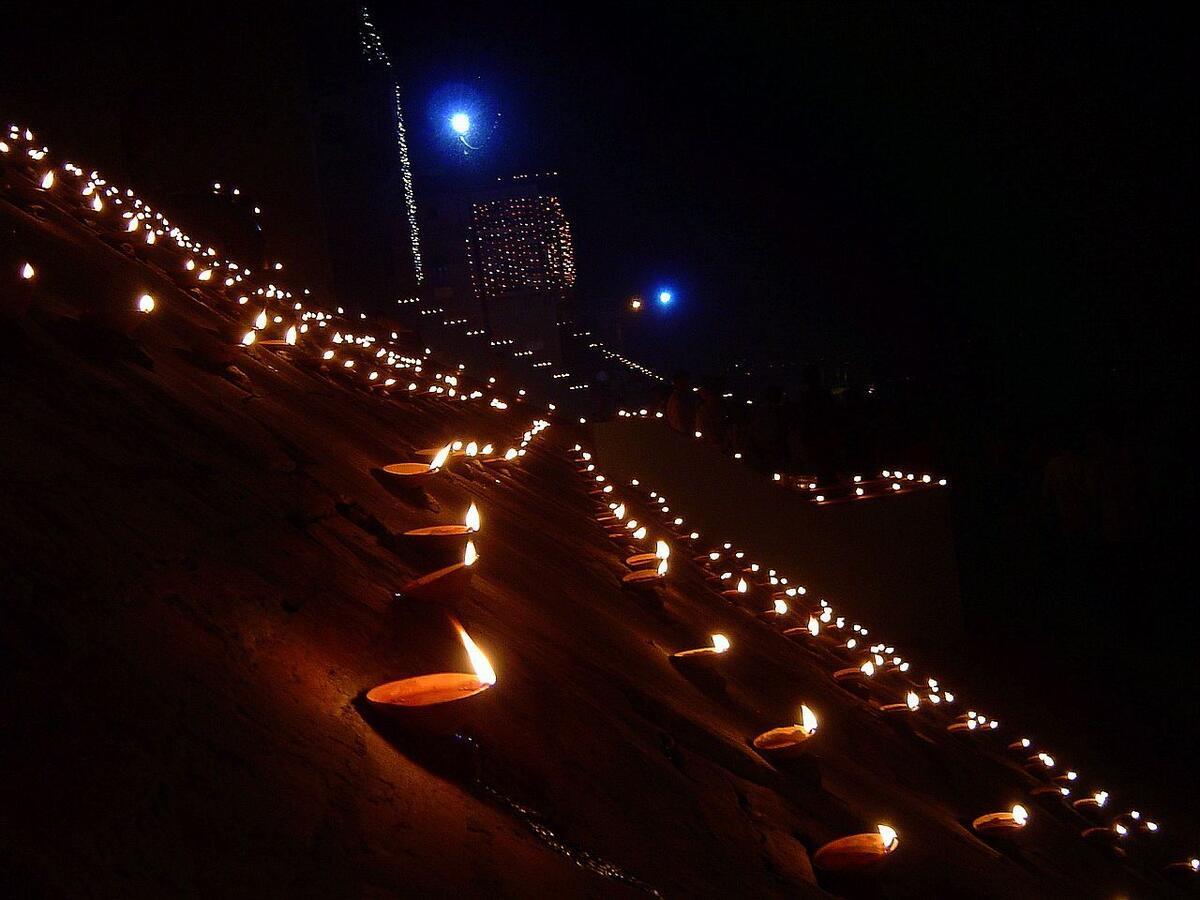
November to February is Kashi at its kindest and most crowded — Dev Deepawali's lakhs of lamps, fog-wrapped dawn boat rides, the dawn-only dessert called malaiyo, what to pack, and why winter yatras must be booked months ahead.
Durga Mandir and Durga Kund: The Red Temple Where the Devi Chose to Stay
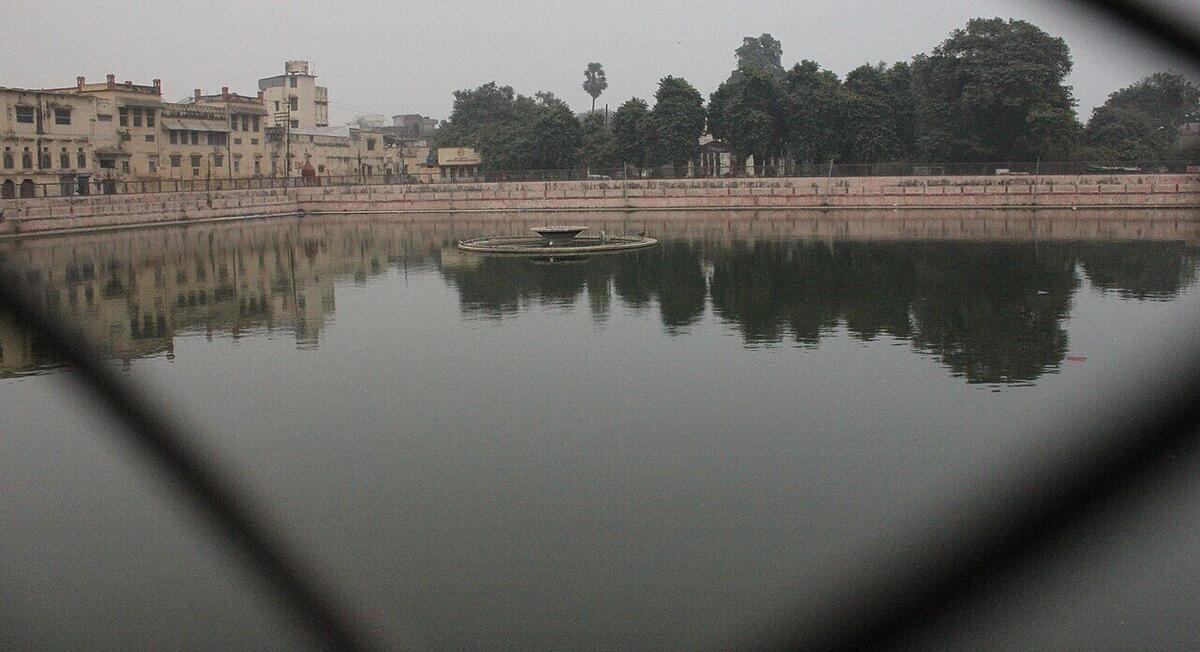
The 18th-century red temple of Durga Kund — built by Rani Bhabani of Natore around a murti tradition holds no sculptor ever made, beside a sacred tank older than memory. History, legends, Navratri in Kashi, and a pilgrim's visit plan.
The New Vishwanath Temple at BHU: Malaviya's Marble Vision, Open to All
Inside the great marble Shiva temple of Banaras Hindu University — Madan Mohan Malaviya's vision, the Birla family's decades of building, a sanctum open to every caste and creed, scripture-inscribed walls, and how to plan your campus visit.